Cart (0 Items)
Your cart is currently empty.
View ProductsIt looks like you are visiting from outside the EU. Switch to the US version to see local pricing in USD and local shipping.
Switch to US ($)
With 25+ years of experience and a track-record of more than 500 phage display projects, ProteoGenix can confidently guide you to your project’s success and offer the strongest guarantees of the market.
Why ProteoGenix
Discover why more than 9,000 researchers choose ProteoGenix.
Guaranteed Results
If fewer than three qualified binders are identified, we screen 96 additional clones at no extra cost.
Library diversity
Access human, rabbit, camelid, dog, cat, and more phage display libraries selected for your project.
Proprietary Libraries
Immune, naïve and disease-specific libraries, including human cancer and autoimmune repertoires.
Fully Custom
Library choice, panning and screening are adapted to your antigen and success criteria.
No hidden fees
No royalties, milestone fees or licensing restrictions. The agreed sequences belong entirely to you.
Scientific guidance
Your dedicate PhD Expert will guide you and provide advice throughout your entire project
Proprietary screening resources
Screen against 14 proprietary immune and naïve libraries covering human (including unique cancer and autoimmune repertoires), camelid (VHH), rabbit, dog, cat, goat, and sheep species, alongside robust peptide libraries. Together, this portfolio offers more than 200 billion clones with an in-frame rate of at least 93%—engineered to deliver high-affinity hits, fast.
14
proprietary libraries
7
species represented
>200B
combined clones
≥93%
in-frame sequences
Get high-affinity binders immediately designed for your application. Immune libraries allow strong hit rate with fewer panning rounds.
| Library | Species | Format | Donor | Diversity |
|---|---|---|---|---|
| LiAb-SFCOVID-19™ | Human | scFv | Donors who recovered from COVID-19 | 1.19 x 10¹⁰ clones |
| LiAb-SFCANCER™ | Human | scFv & Fab | PBMCs & BMMCs from 86 Human Donors 18 different cancers Lung, Breast, Prostate, Colorectal, Pancreatic, Bladder, Stomach, Liver, Renal, Uterine, Ovarian, Skin, Thyroid, Lymphoma, Acute myeloid leukemia, Multiple myeloma, B-acute lymphoblastic leukemia (B-ALL), B-lymphoblastic lymphoma (B-LL) |
6.81×10¹⁰ scFv & 6.72×10¹⁰ Fab |
| LiAb-SFAUTOIMM™ | Human | scFv & Fab | PBMCs & BMMCs from Human Donors 12 different autoimmune diseases Sjogren’s Syndrome, Psoriasis, Psoriatic Arthritis, Rheumatoid Arthritis, Systemic Lupus Erythematosus, Crohn’s Disease, Ulcerative Colitis, Ankylosing spondylitis, Autoimmune hepatitis, Scleroderma, Mixed connective tissue disease, Polymyositis |
1.08×10¹¹ scFv & 1.06×10¹¹ Fab |
| Your custom library | Your choice | Your choice | Your choice | Your choice |
Naïve libraries are good for low-immunogenic targets while being animal-free. The resulting antibodies are ideal for broad applications but will probably need affinity maturation.
| Library | Species | Format | Donors | Diversity |
|---|---|---|---|---|
| LiAb-SFMAX™ | Human | scFv & Fab | 368 healthy donors from 5 ethnic groups | 5.37 x 10¹⁰ clones |
| LiAb-SFa™ | Human | scFv | / | 1.5 x 10⁹ clones |
| LiAb-Fab™ | Human | scFv | / | 2.00 x 10¹⁰ clones |
| Liab-VHHMAX™ | Camel, llama, alpaca | VHH | 76 healthy animals | 2.77 x 10¹⁰ clones |
| LiAb-SFDog™ | Dog | scFv & Fab | 46 healthy animals from 6 breeds: Beagle, German Shepherd, Labrador, English Coonhound, Great Dane, Chinese Rural Dog | 1.05 x 10¹⁰ scFv 1.01 x 10¹⁰ Fab |
| LiAb-SFCat™ | Cat | scFv & Fab | 52 healthy animals from 8 breeds: Ragdoll, Maine Coon, Persian, Domestic Shorthair, Domestic Longhair, American Shorthair, Siamese, Bengal | 1.32 x 10¹⁰ scFv 1.21 x 10¹⁰ Fab |
| LiAb-SFRab™ | Rabbit | scFv & Fab | 40 healthy animals from 4 breeds: New Zealand White, Himalayan, Japanese White & Hare | 1.09 x 10¹⁰ clones |
| LiAb-SFGoat | Goat | scFv & Fab | 20 donors, 5 key breeds used for meat and milk | 1.00 x 10⁹ clones |
| LiAb-SFSheep | Sheep | scFv & Fab | 25 donors, 6 key breeds used for meat and wool | 1.00 x 10⁹ clones |
| LiPep-12 | / | Peptide 12-mer | / | 1.00 x 10⁹ clones |
| LiPep-7 | / | Peptide 7-mer | / | 1.00 x 10⁹ clones |
Which library is right for your target? Selection depends on antigen format, conservation, immunogenicity, desired species and binder format, required affinity, and downstream assay. We can screen one library or combine complementary repertoires to maximise the probability of success.
From antigen to validated binder
Each campaign is fully customized, but every project follows our rigorous, 5-step phase gate process to ensure maximum success.

Antigen QC and library selection

4–6 rounds of biopanning with backup storage at each round

ELISA screening of at least 96 single phage binders

Sequencing and unique clone identification

Delivery of sequences, detailed reports and IP
Comprehensive project report
Complete description of methods,
results and conclusions.
Lead antibody sequence
The amino acid sequence of your
selected binder.
Full IP ownership
All agreed sequences transferred
with no royalties or licensing fees.
Application-specific selection
Every project starts with your target. We adapt the biopanning strategy and the library to the biological reality of your project. Below are the five approaches we deploy depending on your antigen and discovery objective.
Standard protein panning
For soluble, correctly folded antigens. Campaigns generally use 4–6 panning rounds against immobilized target, followed by screening of at least 96 individual clones and sequencing of positive binders.
Peptide panning
The target can be conjugated to alternative carriers across rounds, combined with depletion against carrier alone. This reduces carrier-specific enrichment and favors recognition of the intended peptide or hapten.
Neutralizing-binder strategy
Ligand competition, masked-epitope depletion or competitive elution can enrich binders directed toward functional interfaces and active sites rather than non-functional epitopes.
Cross-reactive strategy
Alternating cross-panning between related antigens enriches binders that recognize shared epitopes. Mixed-antigen rounds can be used first when the targets are highly divergent.
Counter-screen strategy
Pre-depletion against a structurally related counter-antigen before each round removes cross-reactive binders and drives selectivity toward the target epitope. Competitive elution in final rounds sharpens specificity further.
Let’s choose the right strategy
Every target is different. We’ll recommend the optimal library and biopanning strategy based on your antigen, application and project objectives.
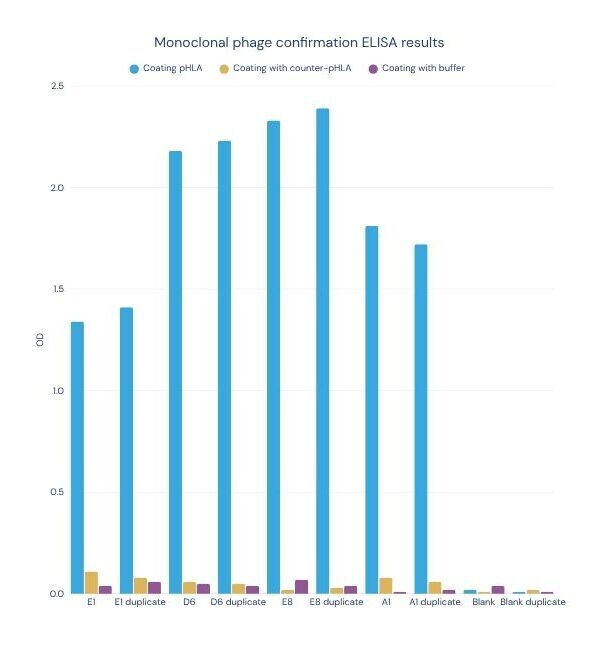
An American pharmaceutical company was developing a next-generation CAR-T therapy targeting a melanoma-specific peptide-HLA complex.
The main challenge was selectivity. The antibody had to recognize the target peptide presented by the HLA molecule on tumour cells, while avoiding the same HLA molecule when presenting irrelevant or self-peptides.
To address this challenge, we applied a counter-screen phage display strategy using three complementary libraries:
Results:
Optional downstream support
The phage display page remains focused on phage selection. When required, selected sequences can move into dedicated downstream services without duplicating those services here.
AI-driven affinity maturation
Structure-aware AI variant design combined with wet-lab validation.
Up to 1000 fold affinity improvement
AI-powered developability improvement
In silico screening of your binder sequences for liabilities, aggregation, thermostability…
Powered by 3D modeling
Antibody engineering
Convert your hit into any therapeutic format: IgG, Fab, scFv-Fc, VHH-Fc, bispecific, ADC…, with available Fc engineering for effector function modulation.
Extensive IP-free portfolio
Recombinant antibody production
From sequence to purified antibody in 2–3 weeks via XtenCHO™ Race. All formats: IgG, Fab, VHH, scFv…
Powered by XtenCHO™ Race

National Cancer Centre, Singapore
“We have been working together with ProteoGenix since 2020. Using phage display, they helped our team to develop several antibodies with effective blocking effects. We are pleased with their services and look forward to continue working together with them as we advance our research and bring the biologics to clinical stage.”
Prof Johnny Ong Chin-Ann, MD, PhD, Group leader

aTyr Pharma, USA
“All three of the antibodies you delivered were reformatted into IgGs and worked well. Interestingly two were d1 binders, and one was a d1/d2 binder when we domain mapped them here. They were good “protein X” blocking antibodies. But none were “protein Y” blockers. They express reasonably well. Overall we are quite happy with them.”
Senior scientist

Nanyang Technological University, Singapore
“ProteoGenix has been generous and sincere in supporting an academic laboratory like ours. They were able to identify several antibody sequences via phage display against a protein antigen and they screened twice more phages than initially planned to help us succeed in our project. ProteoGenix team was reactive and diligent in their replies and services.”
Alvin Chew, Research Fellow
Scientific track record
Nature – 2024
2 neutralizing antibodies (C9 & B3) with nM affinity against cancer target; C9 now in Phase I clinical trial LiAb-SFMAX™ (human naïve)
Clinical Cancer Research – 2024
Neutralizing antibody (A5) cross-reactive with 3 antigen conformations, nM affinity LiAb-SFMAX™ (human naïve)
Nature – 2025
Epitope mapping of SARS-CoV-2 Spike protein; mAbs developed using ProteoGenix phage display service with LiAb-SFCOVID-19™ LiAb-SFCOVID-19™
NCT06645808 – 2024
Antibody C9 tested in cancer patients — Phase I LiAb-SFMAX™ (human naïve)
EP4209511A1 – 2022
An antigen-binding domain, antibody or chimeric antigen receptor that binds to CD84.
WO2021237159A1 – 2021
Anti-syndecan-2 antibodies for treating acute respiratory distress syndrome
WO2024160736A1 – 2024
Human anti-trem2 antibody for treating neurodegenerative disorders
WO2024254399A2 – 2024
Anti-ToH1 antibodies for diagnosis and treatment of microbial disease and/or chronic inflammatory disease
WO2025062271A1 – 2024
Monoclonal antibodies that specifically binds the hNTRK2 receptor in therapy and prophylaxis of endometriosis or related conditions
WO2023161448A1 – 2023
Antigen binding polypeptides, including antibodies that have a high degree of sequence and structural homology with the variable domains of human antibodies.