Cart (0 Items)
Your cart is currently empty.
View ProductsIt looks like you are visiting from outside the EU. Switch to the US version to see local pricing in USD and local shipping.
Switch to US ($)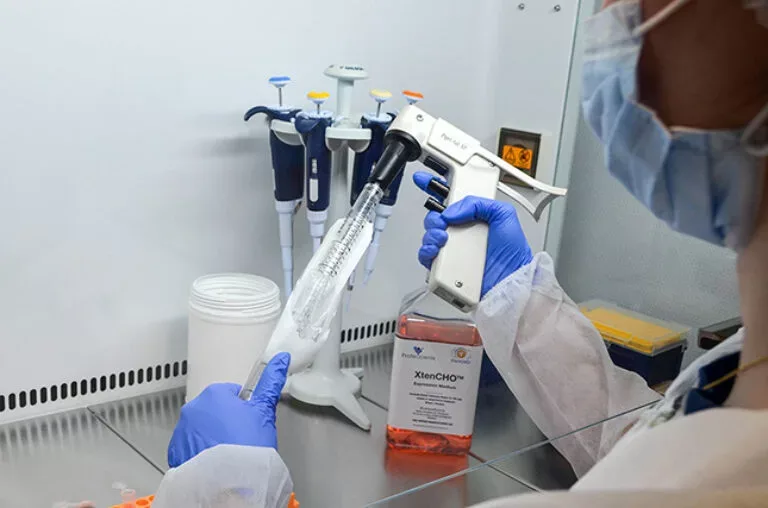
From IgG-like to fragment-based formats, we design and produce the bispecific antibody format that fits your target, application and development stage.
Discuss your projectTalk to our experts
Start from existing antibody sequences or involve our team earlier for discovery and engineering.
Bispecific antibody formats
With expertise spanning IgG-like and fragment-based, symmetric and asymmetric bispecific antibody formats, we help select and produce the format best suited to your target, application, performance requirements and budget.
BiTE
Diabody
DART
DVD-Ig
IgG(H)-scFv
scFv-(L)IgG
HSAbody
Fab-scFv
IgG-IgG
F(ab’)2
40+ bispecific formats
Looking for another format? Discuss your project with our experts.
Correct chain pairing is the central engineering challenge of any IgG-like bispecific. We combine the right techniques depending on your project and format of choice.
Knob-into-Hole (KIH)
Promotes correct heavy-chain heterodimerization.
Solves: heavy chain / heavy chain mispairing
CrossMab
Domain crossover guides correct light-chain association.
Solves: light chain / heavy chain mispairing
Kλ-body
Uses kappa and lambda light chains to support correct pairing.
Solves: light chain / heavy chain mispairing (via downstream separation, not steric design)
Duobody
Controlled Fab-arm exchange generates bispecific IgG molecules.
Solves: heavy chain pairing, without co-expression
Dock and Lock
Uses complementary dimerization and anchoring domains.
Solves: multi-domain assembly beyond simple 1+1 bispecifics
Bispecific antibody development
Developing a bispecific antibody is often complex: format choice can influence binding behavior, stability, half-life, manufacturability and therapeutic potential. We help you compare relevant formats and make data-driven go/no-go decisions before scale-up.
01
Project Study & Format Selection
We understand your goals, project feasibility and constraints, then help select the most relevant formats for your application.
02
Transient Expression
03
Core Quality Control
04
Optional Developability Controls
05
Delivery
06
GO / NO-GO Checkpoint
Review the data with our experts and decide whether to proceed to additional analytical testing, functional validation and/or scale-up.
Bispecific antibody production
Bispecific antibodies are expressed using the high-performance proprietary XtenCHO™ Race platform. Antibody gene sequences are optimized specifically for this system to ensure high yields and low endotoxin levels.
mg → grams
production scale
Up to 98%
purity
1 g/L
yield in stable cell line
<0.1 EU/mL
endotoxin upon request
Already have antibody sequences or need support earlier in development? Tell us where your project stands and our team can help define the next step.
Not sure which service or format you need?
Send us your project requirements and our team can help you identify the most appropriate approach.
Scale-up
Move from early-stage production to larger, reproducible supply through stable cell line development.
XtenCHO™ Race
Proprietary cell line
Stable cell line development
Gram-level and larger-scale production
Customizable endotoxin level
According to project requirements
Intellectual property
Fully IP-Free, From Sequence to Cell Line
The sequences, the antibody, and the cell line stay yours, with no shared IP and no royalties down the line from ProteoGenix.
- No IP constraints or royalties from ProteoGenix
- Our experts can help you avoid mutations patented by others
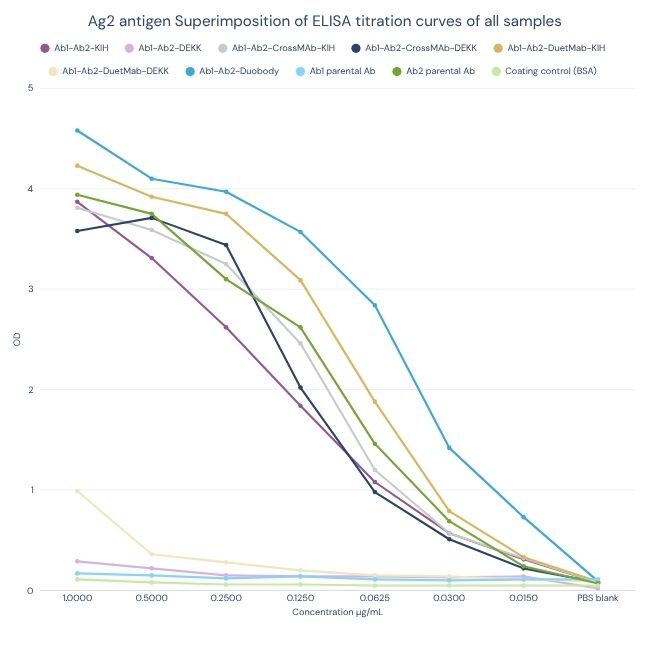
Case report
A Swedish biotech company trusted ProteoGenix with the design and production of multiple bispecific antibody formats. The customer supplied sequences from two monoclonal antibodies, Ab1 and Ab2, which served as the foundation for bispecific engineering.
Expert guidance
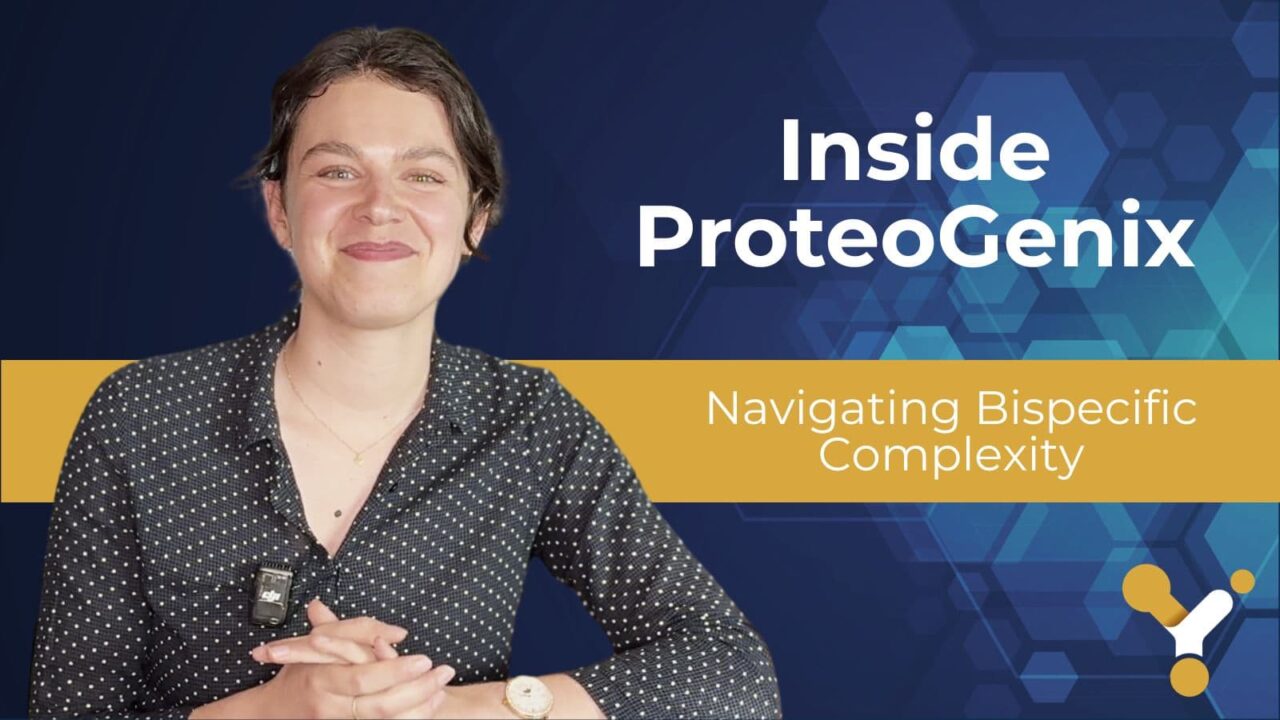
Anne shares her experience guiding a client through a bispecific antibody project — from early design questions to the format decisions that made the difference.
Scientific track record
Selected scientific publications involving bispecific antibody research and development.
Danquah, W., Pichery, M., Eden, T., Boyance, A., Pasquet, L., Roure, V., Mars, M., Marchand, A., Gumz, E., Gador, M., Valente, L., Contini, M., Czernecki, L., Shanmuganathan, S., Barron, P., Chabot, S., Dangl, M., & Niederfellner, G. (2026). Combination therapy with a novel CD2-targeted costimulatory bispecific antibody overcomes limitations of CD3 T cell engager treatment for solid tumors. mAbs, 18(1), Article 2684378.
De Nardis, C., Hendriks, L. J. A., Poirier, E., Arvinte, T., Gros, P., Bakker, A. B. H., & de Kruif, J. (2017). A new approach for generating bispecific antibodies based on a common light-chain format and the stable architecture of human immunoglobulin G1. Journal of Biological Chemistry, 292(35), 14706–14717.
Liu, W., Yang, J., Yan, W., & Peng, K. (2025). Reformation of a clinical anti-drug antibody assay to enable the immunogenicity assessment of a bispecific antibody biotherapeutic. The AAPS Journal, 27(1), Article 12.
View publication
Bray, J. S., Thomas, G. R., Smith, V. M., Jayne, S., Dyer, M. J. S., & Walter, H. S. (2024). Comparative in-vitro efficacy of CD20xCD3 IgG bispecific biosimilar constructs against diffuse large B cell lymphoma (DLBCL) cell lines with different levels of expression of CD20. Blood, 144(Supplement 1), Article 5826.
View publication
Bray, J. S., Thomas, G. R., Smith, V. M., Wright, A., Jayne, S., Dyer, M. J. S., & Walter, H. S. (2025). In vitro comparison of CD20xCD3 bispecific antibodies against diffuse large B-cell lymphoma (DLBCL) cell lines with different levels of expression of CD20. British Journal of Haematology, 206(5), 1350–1354.
View publication
Sandeep, Shinde, S. H., Ahmed, S., Sharma, S. S., & Pande, A. H. (2026). Engineering and partial characterization of an anti-IL-23/anti-TNF-α bispecific domain antibody fused to human serum albumin domain for inflammatory disease therapy. Applied Biochemistry and Biotechnology, 198(7), 5212–5230.
View publication
Interactive tool
Is Your Bispecific Antibody Ready for the Next Step?
Use the checklist prepared by our experts to assess antibody readiness across general and specialized bispecific criteria.
Tell us where your program stands — existing sequences, format selection, pilot production, characterization or scale-up — and our team can recommend the most relevant next step.