Cart (0 Items)
Your cart is currently empty.
View ProductsIt looks like you are visiting from outside the EU. Switch to the US version to see local pricing in USD and local shipping.
Switch to US ($)AI-guided design, expert review and wet-lab validation in 3–4 weeks.
Humanize monoclonal antibodies with AI-guided design, expert review and experimental validation.
Discuss Your Project See How Our AI Humanization Works ↓
Our AI approach
Our AI-powered approach combines computational design with human expertise and experimental validation to accelerate antibody humanization.
The AI design step is powered by AIxplore®, our proprietary antibody engineering AI platform.
01
Humanized antibody variants are generated using our proprietary AI platform, AIxplore®.
02
Every AI output is checked by a ProteoGenix bioinformatician before production.
03
Each variant is ranked on several criteria, including developability, to support candidate selection.
04
Selected humanized variants are produced and experimentally tested in the wet lab.
The result: 5 weeks saved on your project | Up to 22 humanized variants
Multi-criteria variant ranking
During AI-guided design, each variant is ranked across multiple development-related criteria to help prioritize stronger candidates before recombinant production and downstream testing.
Development-related properties are considered during candidate selection, rather than only after humanization.
Multi-criteria ranking helps identify stronger candidates before investing in recombinant production and downstream testing.
AI-generated candidates are reviewed by ProteoGenix experts before they progress to production and wet-lab evaluation.
Criteria considered during candidate selection
Have a challenging antibody? Discuss your humanization strategy →
See how your antibody progresses from sequence analysis and AI-guided design to experimental validation.
01
VH/VL sequence identification and CDR annotation from the source antibody.
02
Humanized sequences are generated using human germline selection and structural analysis, with candidates ranked on binding-related and developability criteria.
03
You review the project report and confirm which variants move forward to recombinant production.
04
Selected humanized variants are produced using the high-throughput expression workflow and purified via XtenCHO-Race™.
05
The variants are evaluated by ELISA and BSA control. Optional analyses include SPR/BLI, SEC-HPLC, nanoDSF and DLS.
The exact workflow can be adapted to your starting material and project stage, including projects that already have VH/VL sequences.
Project deliverables
You receive the sequences, experimental material and project data needed to compare humanized candidates and continue antibody development.
Up to 22 Humanized Variants
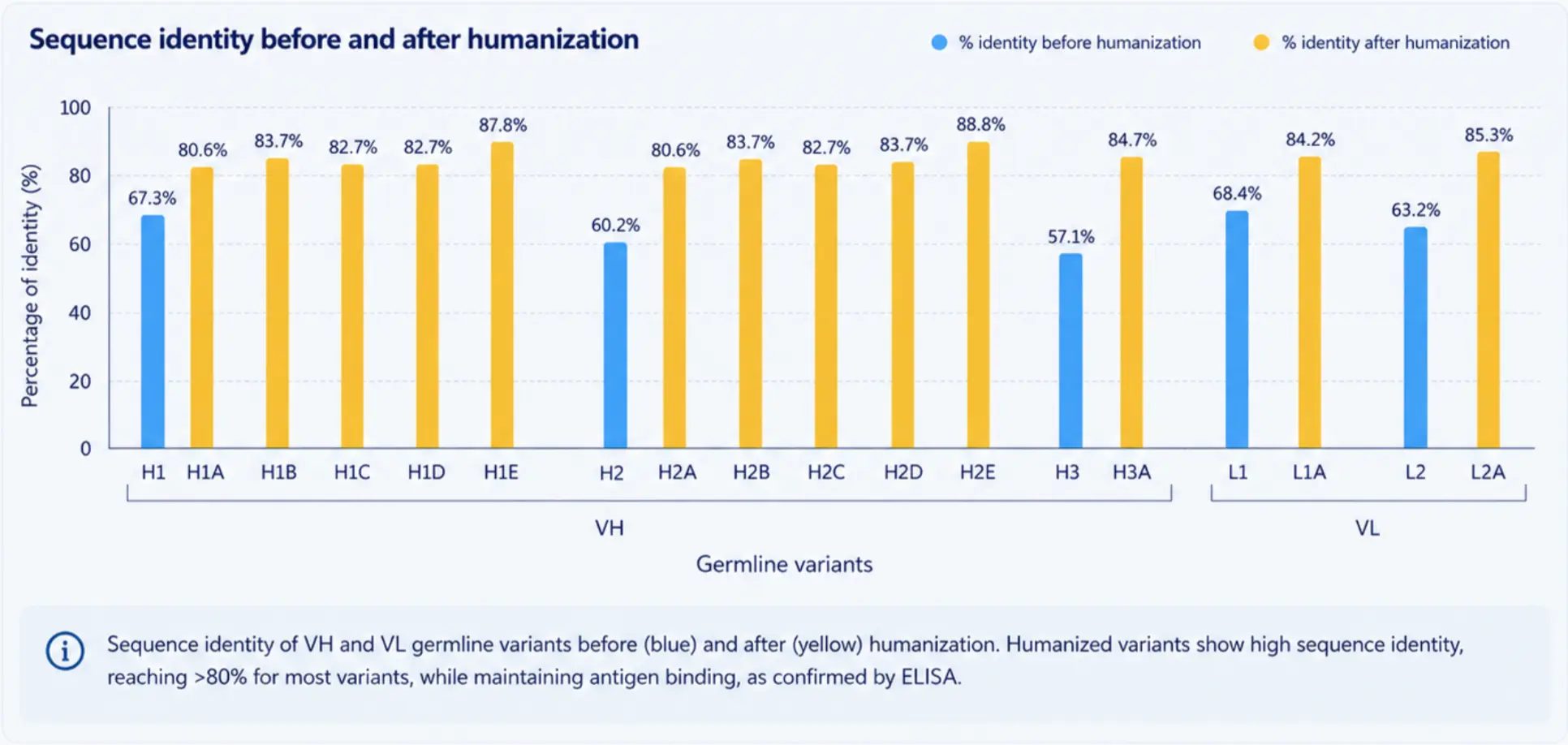
AI-generated humanized antibody variants, with a design target of at least 80% identity.
Purified Recombinant Antibody Samples
Recombinant humanized antibody samples for experimental comparison and downstream testing.
Experimental & QC Data
Production yields, quality-control information and ELISA data, with additional assays available depending on the project.
Detailed Report + Full IP Ownership
Generated sequences, production and analytical data are compiled in the final report. Full IP ownership is transferred to you, with no royalties or milestone payments.
Ready to evaluate your antibody for humanization?
Share your sequence or project details with our antibody team.
Discuss Your Project
Further antibody optimization
Extend the humanization project with additional antibody optimization and recombinant production services without switching providers.
Further design and testing for manufacturability, stability, aggregation and related liabilities.
Optimization of target binding after humanization.
Recombinant production and purification of selected antibody candidates.
Case report
A French biotechnology company partnered with ProteoGenix to humanize a therapeutic antibody while preserving key structural features and evaluating binding after humanization.
22
humanized variants designed with AIxplore®
>80%
human sequence identity achieved for most variants
Structure preserved
VH/VL quaternary architecture and paratope conformational dynamics were preserved
Up to 2.6×
higher ELISA binding versus the parental antibody in several variants
Antibody formats
The humanization workflow can be adapted to the architecture and species origin of different antibody molecules.
Scientific track record
Examples of antibody programs associated with ProteoGenix humanization and downstream antibody development work.
Patent WO2024194298A1 — humanized antibody behind ALZ-201, targeting toxic Aβ42 oligomers for Alzheimer’s disease. ProteoGenix also developed the stable cell line.
Patent WO2024100200A1 — antibody behind CBO-001, an antibody-drug conjugate targeting L1-CAM (CD171) for aggressive cancers.
IW-601 targets MOSPD2. The source page states that Phase 1 was completed with positive safety, PK and mechanistic data, with Phase 2 expected in 2027.
Antibodies against PTHrP for breast and pancreatic cancer, with work published in Cancer Discovery (2021) and the Journal of Clinical Investigation.
A murine monoclonal antibody targeting BAMBI for psoriasis and psoriatic arthritis.
Classical antibody humanization
ProteoGenix also offers classical CDR grafting, the conventional antibody humanization approach used across the industry for decades and our most established route to date.
Compare humanization methods
Compare the two humanization routes by design approach, number of variants, developability integration and project timeline.
| Criterion | Classical CDR Grafting | AI-Guided Humanization |
|---|---|---|
| Design principle | Parental CDRs grafted onto human frameworks, with back-mutations where needed | Germline-guided redesign supported by AI and structural analysis |
| Germline selection | Expert-selected frameworks | Human germlines screened and evaluated during AI-guided design |
| Structural analysis | Case-by-case modeling | Structural analysis integrated before production |
| Variants | 18 | Up to 22 |
| Developability approach | Separate optional step | Criteria considered during candidate ranking |
| Turnaround | 9 weeks | 3–4 weeks |
| Expert review + wet-lab validation | Yes | Yes |
| Guarantee | No win, no fee | No win, no fee |
Start your antibody humanization project
Tell us about your antibody and project requirements. Our antibody engineering team will review your request and recommend the appropriate humanization strategy.
Already have VH/VL sequences? Send them with the form.
Starting from a hybridoma? The project can begin with parental antibody sequencing.