



Cart (0 Items)
Your cart is currently empty.
View ProductsIt looks like you are visiting from outside the EU. Switch to the US version to see local pricing in USD and local shipping.
Switch to US ($)
Develop custom monoclonal antibodies for diagnostics and research with guaranteed performance in 11 applications. Validate the antibody in your own laboratory under your experimental conditions before final acceptance
Hybridoma • Phage Display • Single B-Cell • AI de novo
Proteins • PTMs • Peptides • Whole Cells • Haptens …
ELISA • WB • IHC • FACS • LFA …
Validate the antibody
before final acceptance.
Your antibody, validated in the assay that matters to you. Every custom monoclonal antibody we produce is screened and delivered with performance data in your target application — tested in your own lab, under your own conditions, before you pay in full.
Standard ELISA
Sandwich ELISA
Flow cytometry (FACS)
Immunohistofluorescence
Immunofluorescence
Lateral flow assay (LFA)
Competitive ELISA
Immunoprecipitation
Modification-specific detection
Western Blot
Immunohistochemistry
You test the custom monoclonal antibodies under your real experimental conditions before validating the final delivery — so you only pay in full for antibodies that work where you need them.
We test the antibodies in their final application.
You test the antibodies under your own experimental conditions.
You only pay the full project fee if you are satisfied.
From standard recombinant proteins to the most structurally demanding targets — our multi-platform approach is engineered to handle diversity at every level.
Recombinant proteins
Including challenging targets such as membrane proteins (GPCRs, ion channels), multi-domain complexes, and low-immunogenicity antigens.
Peptides
Ideal for high specificity, PTM detection, or when the protein is unavailable.
Post-translational modifications
Phosphorylation, acetylation, methylation… with modified vs. unmodified antibody validation.
Haptens & small molecules
Conjugated to KLH or BSA. From pesticides, steroids and toxins to lipids, nucleotides, amino acids and saccharides…
Whole cells & VLPs
Cell-based immunization and panning for membrane proteins in native conformation.
DNA constructs
Useful when the protein is hard to produce. Combines advantages of protein and peptide immunization.
45 days
The gold standard for diagnostic and research-grade antibodies.
• 3 binders guaranteed
• >90% success rate
• 11 guaranteed applications
2 weeks
Fast in vitro selection from high-diversity antibody libraries.
• No immunization required
• 12 high diversity libraries available
• 3 guaranteed binders
8 weeks
Recover naturally paired VH/VL sequences from rare antigen-specific cells.
• 11 applications guaranteed
• High-value targets
• 3 guaranteed clones
2–3 days
Novel antibody sequences designed in silico and validated experimentally.
• Multi-Parameter Optimization
• Predictive design
• No animal model needed
| Platform | Hybridoma | Phage Display | Single B-Cell | AI de novo |
|---|---|---|---|---|
| Typical Timeline | From 7 weeks |
|
From 8 weeks |
|
| Animal immunization | Required | Not required | Required | Not required |
| Species available |
|
|
|
|
| Best for difficult targets | ★★ | ★★★ | ★★★ | ★★★ |
| Guarantee | > 90% success rate, 11 guaranteed applications | 3 guaranteed binders | 3 guaranteed clones, 11 guaranteed applications | Fast discovery |
| Ideal use case | Diagnostics, research | Human research tools, fast leads | Rare epitopes, high-value targets, Diagnostics, research | Complex antigens, toxic or non-immunogenic antigens |
AIxplore® Platform
Rare epitopes. Difficult antigens. Species-specific targets. When conventional discovery approaches reach their limits, AIxplore® designs novel antibody candidates that are experimentally validated in our laboratory before delivery.
• Experimentally validated candidates
• Animal-Free Workflow
* AIxplore® is our AI-powered antibody discovery platform for targets that are difficult or impossible to address with conventional methods.
Receive your antibody sequence in as little as 3 days.
Early optimization for affinity, stability and developability.
Experimental validation to support candidate selection.
Whatever your target, species, or format — every project follows the same clear, managed path with a single expert partner from start to delivery.

Define & Design
We discuss your target and goals, then design and produce the optimal antigen.

Discover
Antibodies generated via the best-fit platform with a custom strategy: hybridoma, phage, single B-cell or AI.

Engineer (optional)
Engineering or conjugation to fit your chosen format.

Production & Validation
Affinity, specificity and functionality characterized in your application of interest.

Deliver
Final antibodies, sequences and full report.
Every project comes with everything you need to use, publish, and continue developing your antibody independently.
Purified antibody
Specified amount of purified mAb, QC-checked by SDS-PAGE and ELISA
Application data
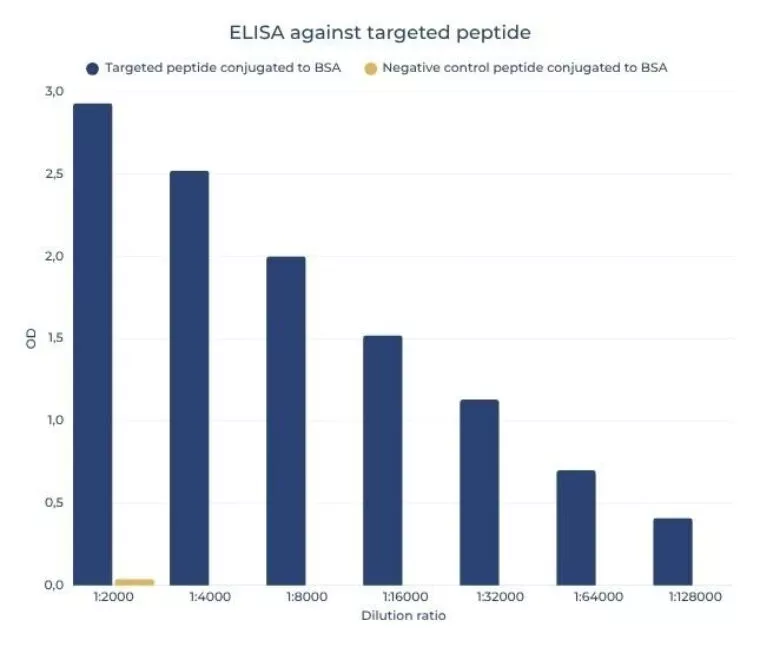
Performance report in your target application: ELISA titer, WB band, IHC staining,…
Cell line / sequences
Hybridoma cell line and/or VH/VL sequences — full IP ownership with no strings attached
Full project report
Detailed technical report with immunization data, screening results and QC records
Whether your project requires the highest affinity, a specific host species, or an engineered antibody format, we tailor the discovery strategy to your scientific objectives—not the limitations of a single platform.
Mouse
Rat
Rabbit
Llama & Alpaca
Cow
Camel
Dog
Cat
Swine
Horse
Human libraries & Humanized mice
Full IgG
All subclasses & species
scFv
Single-chain variable fragment
Fab / F(ab’)₂
Antigen-binding fragments
VHH
Camelid single-domain
Bispecific
BiTE, DVD-Ig, CrossMab & more
Conjugation
ADC with any linker/compound, Conjugated antibodies
Whether you need a conventional monoclonal antibody, a fragment, a single-domain antibody or a conjugated format, we adapt the final molecule to your application.
Dedicated Scientific Support
One scientific expert manages your project from kickoff to delivery, providing direct technical support at every stage.
Proven Expertise
ProteoGenix antibodies have been cited in peer-reviewed journals worldwide, including Nature, PNAS and Scientific Reports.
Trusted Worldwide
From academic laboratories to leading diagnostics and biopharma companies, researchers worldwide trust ProteoGenix.
Certified Quality
Certified quality management and environmental systems ensure reliable processes, traceability and consistent results.
“Working with ProteoGenix, and our dedicated account manager in particular, was a genuinely satisfying experience. When our initial antibody generation strategy needed to be adjusted mid-course, our account manager was responsive and flexible in helping us pivot direction rather than forcing us to stay locked into the original plan. That adaptability ultimately paid off — we ended up with monoclonal antibodies against Kcc1 and Kcc4 that performed well and specifically for our applications, and we’d gladly work with him again.”
“ProteoGenix has been an outstanding partner, with a customer service team that is responsive, knowledgeable, and genuinely invested in our projects. The delivered antibody consistently shows excellent sensitivity and specificity, delivering robust, reproducible signals with minimal background across both ELISA and Western blot applications. Combined with very competitive pricing and staying true to timeline obligations, ProteoGenix offers exceptional value, and we highly recommend them to any lab seeking reliable, bespoke, high-quality antibodies.”
_Dakota Ward, PhD, Scientist II, DMC Biotechnologies, USA
JP Barnier et al., The minor pilin PilV provides a conserved adhesion site throughout the antigenically variable meningococcal type IV pilus. PNAS 118, (45) e2109364118 (2021).
https://doi.org/10.1073/pnas.2109364118
H Cerutti et al., Large scale production and characterization of SARS-CoV-2 whole antigen for serological test development. J Clin Lab Anal 35, (4) 23735 (2021).
https://doi.org/10.1002/jcla.23735
PC Maity et al., IGLV3-21*01 is an inherited risk factor for CLL through the acquisition of a single-point mutation enabling autonomous BCR signaling. PNAS 117, (8) 4320-27 (2020).
https://doi.org/10.1073/pnas.1913810117
M Fresquet et al., Autoantigens PLA2R and THSD7A in membranous nephropathy share a common epitope motif in the N-terminal domain. J Autoimm 106, 102308 (2020).
https://doi.org/10.1016/j.jaut.2019.102308
P Cunha et al., Expansion, isolation and first characterization of bovine Th17 lymphocytes. Nature Sci Rep 9, 16115 (2019).
https://doi.org/10.1038/s41598-019-52562-2
M Krifa et al., Limoniastrum guyonianum aqueous gall extract induces apoptosis in human cervical cancer cells involving p16INK4A re-expression related to UHRF1 and DNMT1 down-regulation. J Exp Clin Canc Res 32, (30) (2013).
https://doi.org/10.1186/1756-9966-32-30
E Faure et al., Probable presence of an ubiquitous cryptic mitochondrial gene on the antisense strand of the cytochrome oxidase I gene. Biol Direct 6, (56) (2011).
https://doi.org/10.1186/1745-6150-6-56