








Cart (0 Items)
Your cart is currently empty.
View ProductsIt looks like you are visiting from outside the EU. Switch to the US version to see local pricing in USD and local shipping.
Switch to US ($)
Discovery Methods
ProteoGenix offers a complete portfolio of antibody discovery technologies — from classical immunization to cutting-edge AI de novo synthesis. Each method has specific advantages for pMHC targets; our experts help you select the optimal strategy or combine approaches to maximize success probability.
Classical immunization followed by B-cell fusion and clonal screening. Our optimized protocols overcome the tolerogenic nature of pMHC.
Direct isolation of antigen-specific B cells followed by single-cell sequencing and recombinant expression.
In vitro panning on our proprietary immune libraries including LiAb-SFCANCER™ and LiAb-SFAUTOIMMUNE™ (>2×10¹¹ clones).
AI Discovery
Generative AI designs antibody sequences from scratch against your pMHC target — no immunization or library required.
“We recommend immunization-based approaches (hybridoma, single B-cell) for natural affinity maturation, and phage display with our immune libraries for its built-in positive/negative pMHC selection. AI de novo is ideal when immune tolerance is an absolute barrier. For best results, combine at least two approaches.”
Immunization Strategy
The choice of antigen used for immunization or library panning has a direct impact on the conformation of the epitope recognized by the antibody — and therefore on its selectivity in physiological conditions.
Full pMHC Complex
The animal is immunized with the intact peptide–MHC complex. Counter-screening against a control pMHC (same MHC + irrelevant peptide) is performed to eliminate antibodies targeting the MHC scaffold alone.
Advantages
Considerations
Synthetic Peptide Only
The animal is immunized with the synthetic peptide of interest. Subsequent screening against the full pMHC complex selects antibodies that recognize the peptide in its MHC-bound conformation.
Advantages
Considerations
“For maximum success, we recommend pursuing both strategies in parallel. The full pMHC approach ensures conformational fidelity; the peptide approach provides a cost-effective complement. Running both simultaneously maximizes the probability of identifying high-quality, selective MHC antibody candidates within a single project timeline.”
Essential Startegy
MHC molecules are conserved and self-tolerated, most antibodies generated will target the MHC scaffold — not the peptide. Our systematic counter-screening against a control pMHC (same MHC + irrelevant peptide) eliminates these off-target clones and ensures every delivered binder is truly peptide-specific.
Scientific Context
Understanding pMHC biology is essential for appreciating why developing antibodies against these targets demands specialized expertise.
Presents endogenous peptides (~8–11 amino acids) generated by the proteasome and loaded in the endoplasmic reticulum. Expressed on all nucleated cells, it allows CD8⁺ cytotoxic T cells to detect infected or malignant cells.
Human molecules: HLA-A HLA-B HLA-C
Therapeutic relevance: primary target for cancer immunotherapy and CAR-T cell engineering.
Presents exogenous peptides (~13–18 amino acids) loaded in endosomal/lysosomal compartments. Expressed primarily on professional antigen-presenting cells (dendritic cells, macrophages, B cells).
Human molecules: HLA-DP HLA-DQ HLA-DR
Orchestrates adaptive immunity: activates CD4⁺ helper T cells, B cells, and cytokine production.
Recombinant Antigen
Before antibody discovery begins, you need high-purity recombinant pMHC. ProteoGenix offers multiple expression strategies, each with distinct trade-offs in glycosylation, yield, and peptide flexibility. We recommend the optimal system for your specific HLA allele and peptide.
| Strategy | System | Expression Mode | Glycosylation | Key Advantages | Limitation |
|---|---|---|---|---|---|
| Separate chains + Refolding | E. COLI | Inclusion bodies → refolding | None | Cost-effective; stable even without peptide | Allele/peptide-dependent refolding efficiency |
| Single-chain fusion (β2m–linker–MHC) | MAMMALIAN | Soluble, secreted | Native | Native glycosylation; high yield; stable secretion | May be unstable/low yield without peptide fusion |
| Separate chains co-expression | MAMMALIAN | Secreted into medium | Native | Native glycosylation; flexible peptide loading | Chain dissociation risk during purification |
| Single-chain fusion (β2m–linker–MHC) | E. COLI | Inclusion bodies | None | Rare single-chain format without eukaryotic system | Insoluble by default; complex refolding |
* Feasibility assessment required for mass spectrometry QC on peptide loading.
Immunization Species
Species selection is critical for pMHC antibody projects, where immune tolerance and epitope coverage are major determinants of success.
Rabbit (recommended)
Superior antibody diversity, affinity, sensitivity, and specificity compared to rodent species. Ideal for complex, poorly immunogenic targets like pMHC. Broad germline repertoire generates epitope coverage not achievable in mice.
Humanized Mice
Highly relevant when immune tolerance to human MHC is the primary barrier. Genetically engineered to produce human antibody sequences, bypassing self-tolerance constraints. Delivers fully human antibody candidates.
Human (Phage Display / AI)
Fully human antibodies from proprietary immune libraries or AIxplore® de novo design. No animal immunization required. Critical advantage: bypasses all host immune tolerance constraints entirely.
Custom advice
Unsure which technique fits your project the best? Contact us for personalized advice from our experts.
ProteoGenix manages every step of the anti-pMHC antibody development process — you benefit from a single partner accountable for the full project outcome.
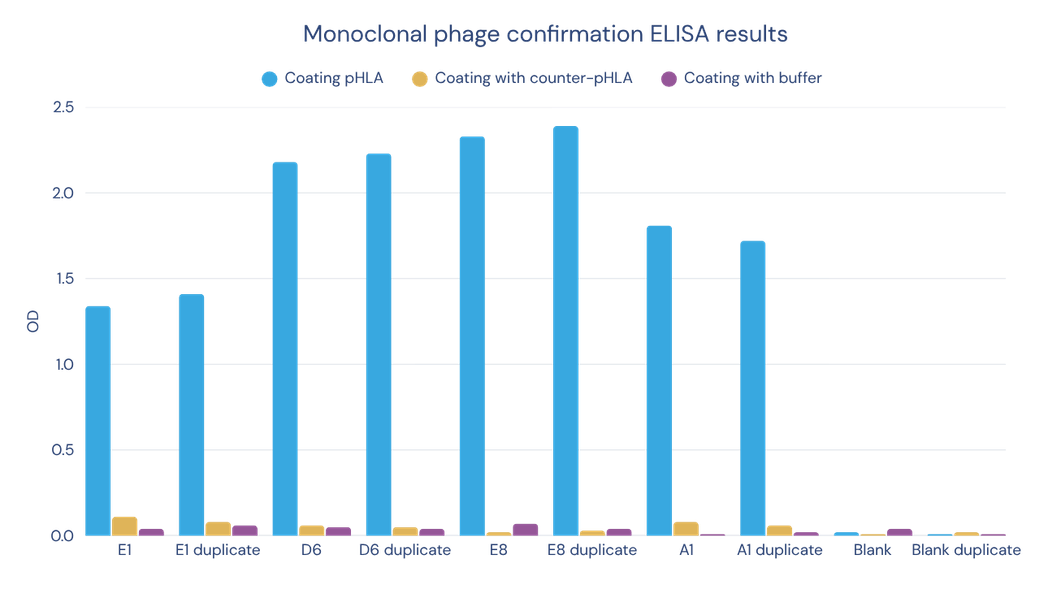
Case Report
Rapid Discovery of Selective Anti-pHLA Antibodies for CAR-T Cell Therapy in Melanoma
An American pharmaceutical company needed antibodies targeting a melanoma-specific peptide–HLA (pHLA) complex for CAR-T cell therapy — with zero tolerance for cross-reactivity with the same HLA presenting irrelevant peptides. A single amino acid difference had to be reliably discriminated.
Experts’ Answers
Frequently Asked Questionss from scientists working on pMHC targets
Full Platform