Cart (0 Items)
Your cart is currently empty.
View ProductsIt looks like you are visiting from outside the EU. Switch to the US version to see local pricing in USD and local shipping.
Switch to US ($)Map your epitope and paratope with AI
ProteoGenix uses proprietary AI to identify predicted antibody–antigen interfaces from sequence data, covering linear, conformational and discontinuous epitopes.
AI-based
No sample or crystals required
2-in-1
Epitope & paratope mapping
10⁹
Docking poses analyzed
10Bn
Sequences in our proprietary AI
AIxplore® technology
Our proprietary AI models the physical interaction between antibody and antigen, working from sequence alone and incorporating structural information when available.
01
Massive-scale docking
Up to 10⁹ possible binding poses are generated to explore the antibody–antigen interaction space.
02
3D modeling & ranking
Docking poses are ranked using 3D modeling, with the top 30 solutions retained for expert review.
03
Biological interpretation
The output focuses on residues, binding patches and interpretable interaction types.
04
Expert-reviewed results
Predictions are interpreted by the ProteoGenix bioinformatics team before inclusion in your report.
From mapping to decisions
Turn mapping results into practical information for candidate selection, developability, IP strategy and downstream development.
01
Select your best candidate
When comparing several binders, mapping shows which target distinct, non-overlapping regions, and which are functionally redundant.
02
Strengthen your patent strategy
A defined epitope and paratope can provide additional molecular information for antibody IP strategy.
03
De-risk developability early
Interface chemistry, including hydrophobic patches and salt-bridge dependence, can provide information relevant to aggregation or pH-sensitivity risks.
04
Guide downstream development
Use the mapped antibody–antigen interface to inform subsequent characterization and engineering decisions.
Beyond the binding site
From the same project, additional in silico analyses can provide biological insights relevant to your antibody program.
Compare your antibody’s predicted epitope to a reference binder to assess overlap or distinct targeting.
Compare the predicted epitope to a known ligand-binding region to assess potential neutralizing or blocking activity.
Assess whether the epitope is conserved across species, informing which preclinical models will be relevant.
Assess whether the epitope sits on a conserved or divergent region relative to paralogs, informing off-target risk.
Assess whether the epitope is present across all isoforms or specific to one, relevant for diagnostic targeting.
Assess whether your antibody is likely to depend on native folding, helping inform assay-format selection.
Assess whether the epitope is accessible on the monomer alone or requires the multimeric assembly.
Assess whether binding is likely pH-sensitive, and explore paratope modifications to introduce pH-dependent binding.
Custom analysis
Need something specific?
Our team can design custom in silico analyses tailored to your target and your project’s questions.
Epitope types
Our proprietary AI pipeline supports mapping of linear, conformational and discontinuous epitopes.
Formed by a continuous stretch of amino acids in the antigen’s sequence. Independent of 3D folding.
Depend on the antigen’s 3D fold to bring the relevant residues into a binding-competent shape.
A specific case of conformational epitopes: residues distant in sequence, brought together in space once the antigen folds.
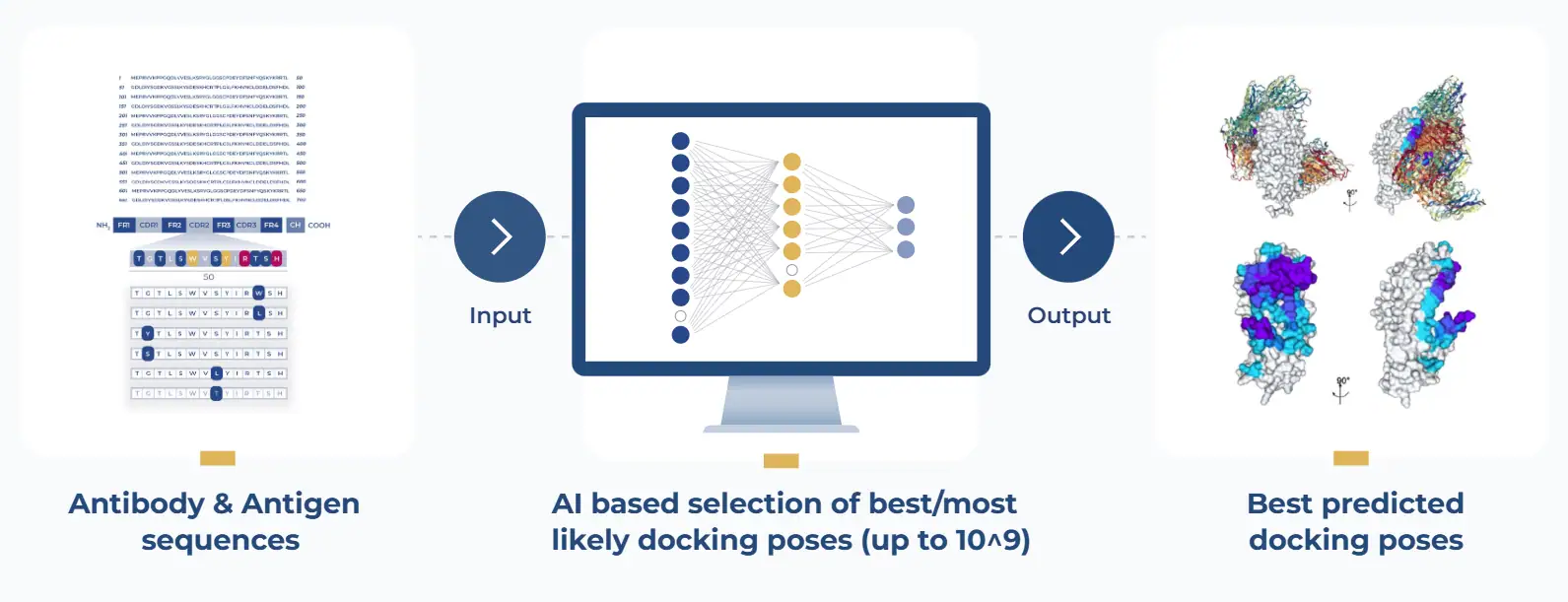

Provide antibody and antigen sequences and as much relevant biological information as possible.

The pipeline combines ProteoGenix AI models and docking-based methods.

Amino-acid patches on the antigen and the corresponding antibody interface are predicted.

Results are reviewed and interpreted before delivery.
Antibody IP strategy
A defined epitope and paratope provide molecular information that can help support antibody characterization and IP strategy.
By identifying the predicted residues involved in the antibody–antigen interaction, epitope and paratope mapping can complement sequence and functional data when documenting your antibody’s binding characteristics.
Patent filing
What We Provide for Your IP Strategy
- A clear description of the epitope and paratope
- The corresponding sequence data
- The functional and biological effect of the interaction
From mapping to optimization
Paratope mapping helps identify which antibody residues are involved in binding, providing molecular information to guide targeted antibody engineering.
01
Guide Affinity Maturation
Focus variant ranking and selection on residues identified as involved in binding, helping guide affinity maturation toward the antibody–antigen interface.
02
Inform Developability Improvement
Distinguishing residues involved in the paratope from those outside the predicted binding interface can help inform where developability liabilities may be addressed while preserving binding.
Need to optimize your antibody after mapping?
Our team can help define the next engineering step based on your epitope and paratope results.
Prediction + validation
Every project starts with a complete AI-driven map. Add experimental validation whenever your program calls for it.
In silico only
Mutate the residues Level 1 identified, then confirm binding in the lab
1. Mutate
Targeted mutations introduced at the Level 1 residues
2. Produce & purify
Recombinant production, one-step Protein A/G affinity purification
3. QC
UV280 quantification, reduced SDS-PAGE, purity evaluation
4. Confirm binding
ELISA titration vs BSA control (flow cytometry also available)
Controls: parental antibody (positive), human IgG1 kappa/lambda isotype (negative). A second mutagenesis round can be run to definitively lock in the epitope and paratope.
Different epitope mapping methods provide complementary levels of structural and functional information. The appropriate approach depends on your project stage, objectives and validation requirements.
| Method | Output | Use case | Key consideration |
|---|---|---|---|
| AI-powered epitope & paratope mapping 1-week turnaround |
Predicted epitope and paratope residues, interaction types and potential mutations. |
Rapid mapping from sequence data and early-stage antibody characterization. |
No sample or crystal required for AI prediction. |
| Alanine scanning | Functional identification of residues that affect binding when mutated. |
Experimental validation of predicted key residues. | Requires generation and testing of variants. |
| HDX-MS | Solvent-accessibility changes upon antibody binding and broad interface regions. |
Experimental characterization of antibody–antigen interfaces. | Less suitable for some unstructured regions. |
| X-ray crystallography | Atomic-resolution structure of the antibody–antigen complex. | Detailed structural characterization. | Requires successful complex preparation and crystallization. |
| Cross-reactivity screening (ELISA) | Experimental assessment of binding against selected proteins. | Validation of predicted specificity or cross-reactivity. | Depends on the selected protein panel. |
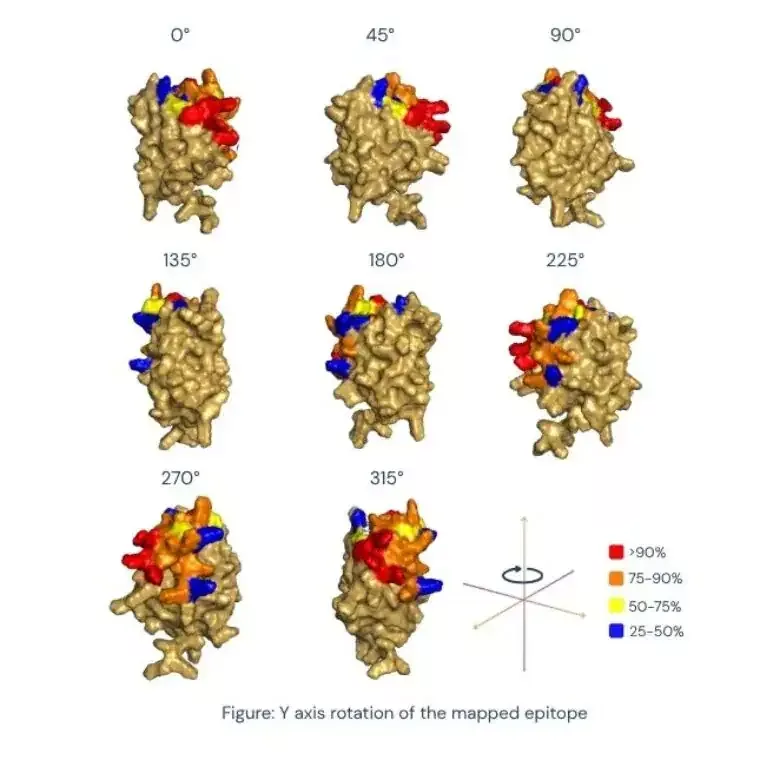
Case report
A biotech company needed to rapidly determine the precise epitope–paratope interactions of a therapeutic antibody candidate.
Understanding these molecular details was critical to predict therapeutic activity, design diagnostic tools, strengthen intellectual-property claims and prepare for antibody engineering such as affinity maturation.
Main Results:
Established CRO
Founded in 2003, based in Strasbourg, France.
25+ Years of Antibody Expertise
Scientific expertise spanning antibody discovery, characterization and engineering.
ISO certifications
ProteoGenix quality is certified ISO 9001 and ISO 14001.
PhD-level guidance
Your dedicated PhD experts provide advice and guide you through your project.
Client testimonial
We have been working with ProteoGenix since 2023 on the discovery of a VHH targeting a highly challenging surface protein. Using their proprietary LiAb-VHHMAX™ library, they successfully identified four specific binders, one of which demonstrated specific target binding wiht no detectable off-targets.
Working hand-in-hand, we continued our partnership on epitope mapping to identify the exact binding site, and ProteoGenix also determined the dissociation constant (KD), which perfectly matched our desired affinity range.
Throughout the process, ProteoGenix’s extensive experience and scientific expertise have been invaluable. Their professional guidance and thoughtful advices helped us make the right strategic choices and advance our project efficiently and confidently.
Shlomit Kfir-Erenfeld
Laboratory Head, Hadassah Medical Center, Israel