Cart (0 Items)
Your cart is currently empty.
View ProductsIt looks like you are visiting from outside the EU. Switch to the US version to see local pricing in USD and local shipping.
Switch to US ($)



| Size | 100ug, 1MG |
|---|---|
| Isotype | IgG-nd |
| Brand | ProteoGenix |
| Product type | Primary Antibodies |
| Clonality | Monoclonal Antibody |
| Expression system | Mammalian cells |
| Applications | Elisa, WB |
| Product name | Labetuzumab Biosimilar - Anti-CEACAM5 mAb - Research Grade |
|---|---|
| Source | CAS 219649-07-7 |
| Species | Humanized |
| Expression system | Mammalian cells |
| Purity | >85% |
| Buffer | PBS buffer PH7.5 |
| Delivery condition | Blue ice (+4°C) |
| Delivery Time | 3-5 days if in stock; 3-5 weeks if production needed |
| Storage condition | store at -80°C |
| Brand | ProteoGenix |
| Aliases /Synonyms | Labetuzumab,hMN14,CEACAM5,anti-CEACAM5 |
| Reference | PX-TA1048 |
| Note | For research use only. Not suitable for clinical or therapeutic use. |
| Isotype | IgG-nd |
| Clonality | Monoclonal Antibody |
Labetuzumab Biosimilar, also known as Anti-CEACAM5 mAb, is a monoclonal antibody that has been developed as a biosimilar to the original Labetuzumab. This antibody specifically targets the carcinoembryonic antigen-related cell adhesion molecule 5 (CEACAM5), which is overexpressed in various types of cancer. In this article, we will discuss the structure, activity, and potential applications of Labetuzumab Biosimilar in the field of cancer research.
Labetuzumab Biosimilar is a recombinant, humanized IgG1 monoclonal antibody that has been engineered to have a similar structure to the original Labetuzumab. It consists of two heavy chains and two light chains, connected by disulfide bonds. The heavy chains contain constant regions (Fc) and variable regions (Fab), while the light chains contain only variable regions. The variable regions are responsible for binding to the target antigen, CEACAM5, while the constant regions are involved in effector functions such as antibody-dependent cellular cytotoxicity (ADCC) and complement-dependent cytotoxicity (CDC).
Labetuzumab Biosimilar binds specifically to CEACAM5, a glycoprotein that is overexpressed in a variety of cancers, including colorectal, pancreatic, and lung cancer. This binding inhibits the growth and spread of cancer cells by blocking the interaction between CEACAM5 and its ligands, which are involved in cell adhesion and signaling pathways. Additionally, Labetuzumab Biosimilar can induce ADCC and CDC, leading to the destruction of cancer cells by the immune system.
Labetuzumab Biosimilar has shown promising results in preclinical and clinical studies as a potential therapeutic agent for various types of cancer. Here are some potential applications of this antibody:
1. Treatment of Colorectal
cancer cells, making it an ideal target for Labetuzumab Biosimilar. In a phase II clinical trial, Labetuzumab Biosimilar showed promising results in combination with chemotherapy in patients with metastatic colorectal cancer. It significantly improved progression-free survival and overall survival compared to chemotherapy alone.
2. Treatment of Pancreatic
cancer is one of the most aggressive and difficult-to-treat cancers. CEACAM5 is overexpressed in pancreatic cancer cells, and Labetuzumab Biosimilar has shown efficacy in preclinical studies. A phase I clinical trial is currently ongoing to evaluate the safety and efficacy of Labetuzumab Biosimilar in combination with chemotherapy in patients with advanced pancreatic cancer.
3. Treatment of Lung
cancer cells, and Labetuzumab Biosimilar has shown promising results in preclinical studies. A phase II clinical trial is currently ongoing to evaluate the safety and efficacy of Labetuzumab Biosimilar in combination with chemotherapy in patients with advanced non-small cell lung cancer.
4. Research Tool for
In addition to its potential therapeutic applications, Labetuzumab Biosimilar can also serve as a valuable research tool for studying the role of CEACAM5 in cancer development and progression. It can be used in various techniques such as flow cytometry, immunohistochemistry, and Western blotting to detect and quantify CEACAM5 expression in cancer cells.
Labetuzumab Biosimilar is a promising biosimilar of the original Labetuzumab, with a similar structure and activity. Its specific targeting of CEACAM5, a protein overexpressed in various types of cancer, makes it a potential therapeutic agent for colorectal, pancreatic, and lung cancer. Furthermore, it can also serve as a valuable research tool for studying the role of CEACAM5 in cancer. Further clinical trials are needed to fully evaluate the efficacy and safety of Labetuzumab Biosimilar, but it holds great
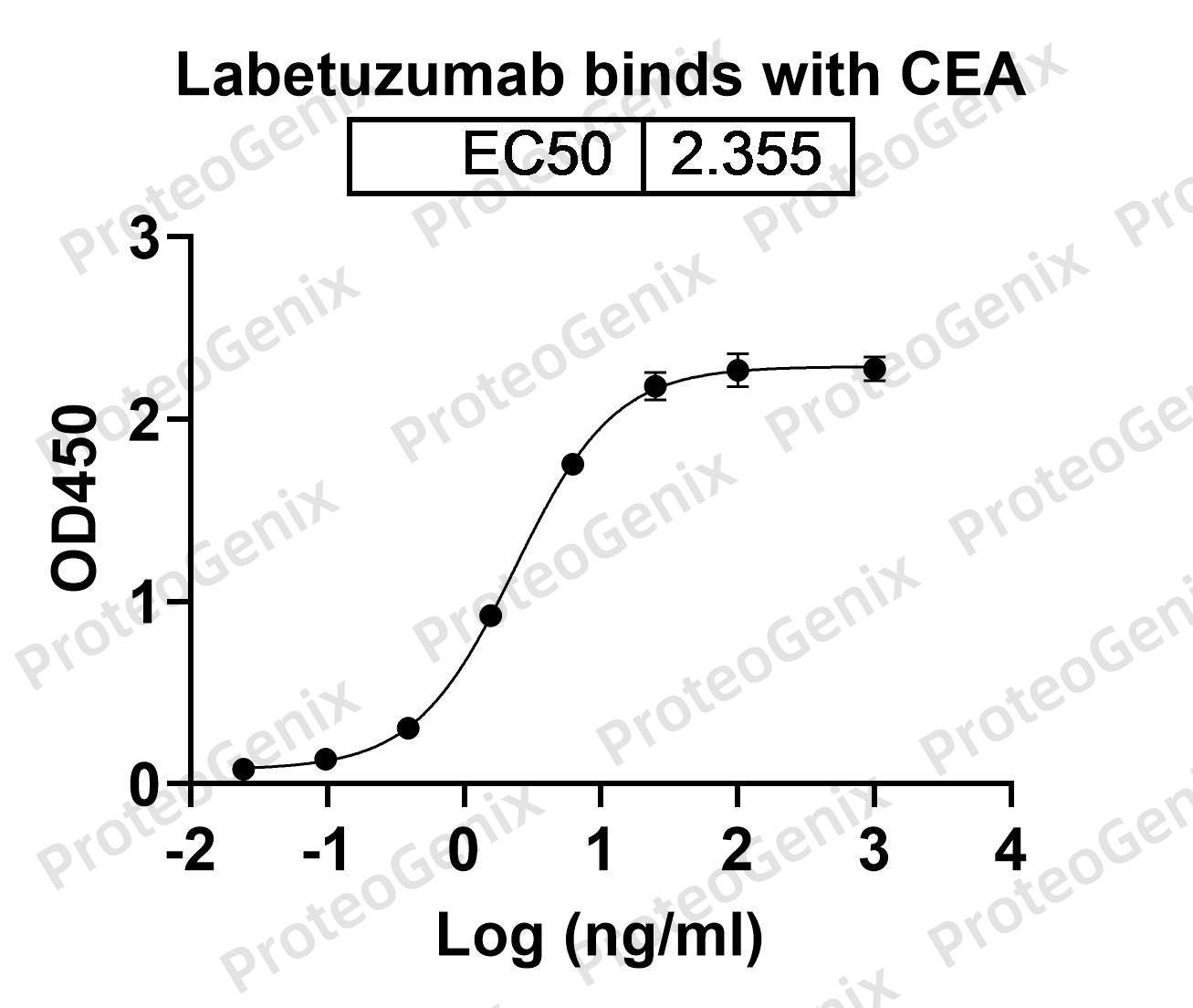
Immobilized CD66e Recombinant Protein (cat. No.PX-P4089) at 0.5µg/mL (100µL/well) can bind to Labetuzumab Biosimilar - Anti-CEACAM5 mAb (cat. No.PX-TA1048) in indirect ELISA with Goat Anti-Human IgG secondary antibody coupled with HRP measured by OD450
Related products


Got a question or need a quote?
Message us and we’ll get back to you 48 hours or less.
Reviews
There are no reviews yet.