Cart (0 Items)
Your cart is currently empty.
View ProductsIt looks like you are visiting from outside the EU. Switch to the US version to see local pricing in USD and local shipping.
Switch to US ($)CUSTOM ANTIBODY DRUG CONJUGATE SERVICES
Site-specific ADC conjugation without prior antibody engineering. Transform your existing antibody into a conjugate with controlled DAR using our proprietary Click chemistry, supported by analytical characterization.
Up to 90% of antibody molecules at the selected DAR
ADC CONJUGATION TECHNOLOGIES
Traditional ADC conjugation methods often involve trade-offs between site specificity, DAR control and antibody preparation. ProteoGenix Click chemistry enables site-specific conjugation without prior antibody engineering, combining precision with a streamlined development process.
| Random conjugation | Enzymatic conjugation | ProteoGenix Click chemistry | |
|---|---|---|---|
| Antibody engineering | No | Generally required, depending on the method | ✓ No prior engineering |
| DAR control | Heterogeneous | Controlled | ✓ Target DAR 1, 2 or 4 |
| IP & licensing | Depends on the linker-payload technology | Depends on the enzyme and conjugation platform | ✓ Clear IP licensing terms |
| Development considerations | Product heterogeneity | Potential engineering and licensing requirements | ✓ Compatible with existing antibodies |
| Main advantage | Established approach | Site specificity | ✓ Site specificity without prior antibody engineering |
FROM NATIVE ANTIBODY TO ADC
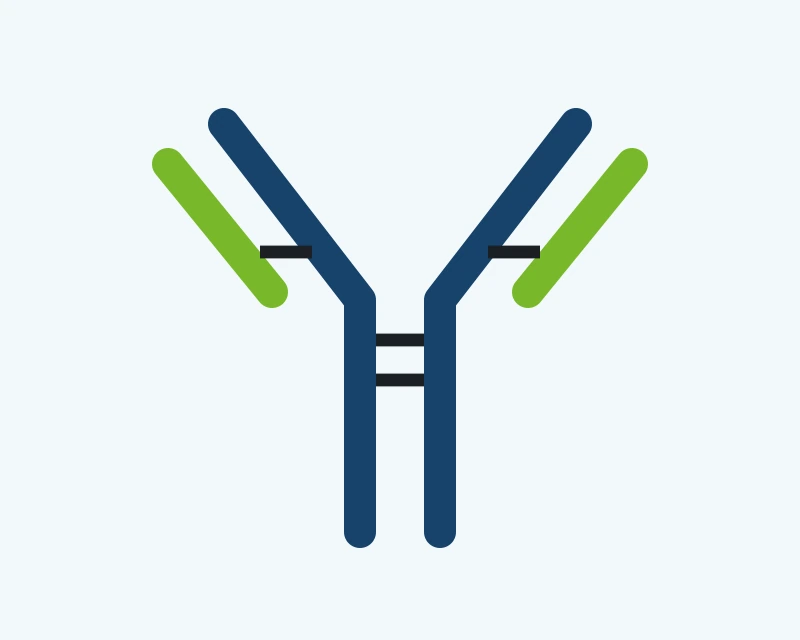
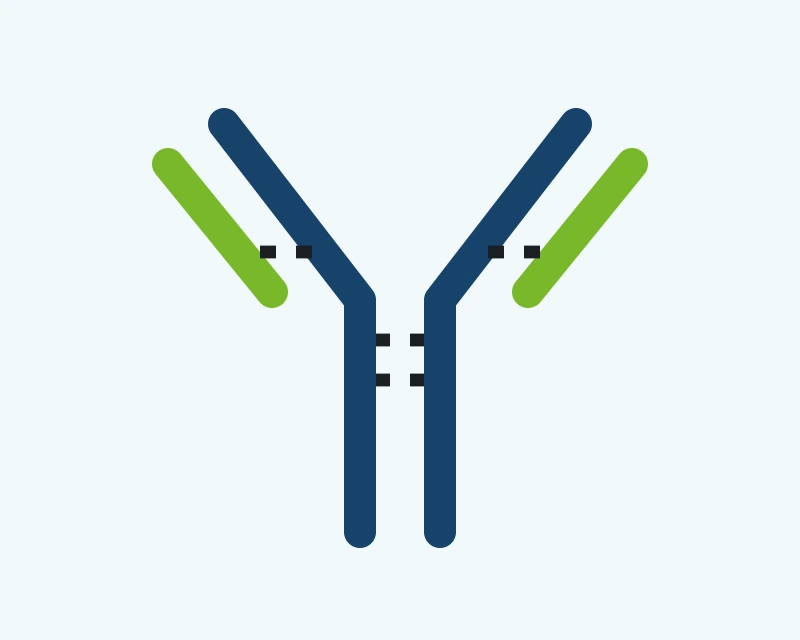
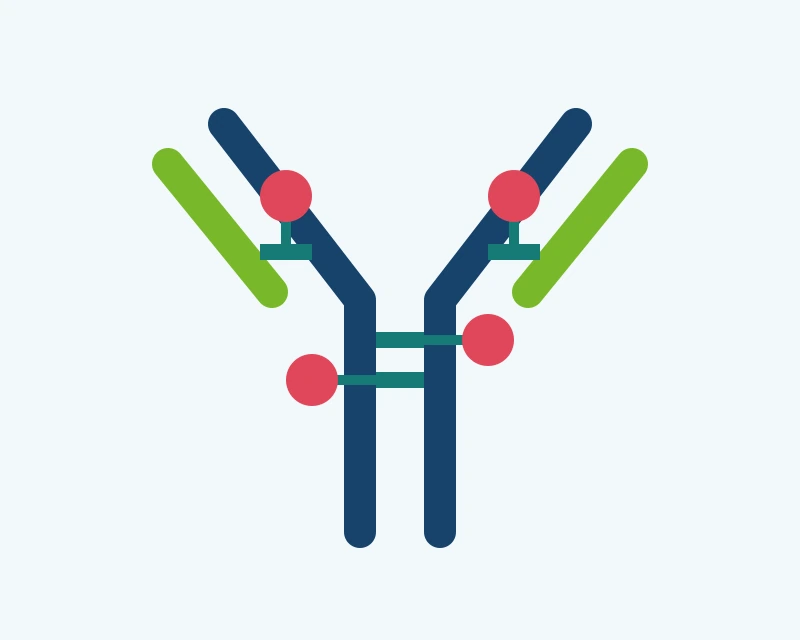
Our proprietary Click chemistry rebridges the antibody’s own interchain disulfide bonds. Your antibody keeps its native sequence, while the payload is attached at defined sites for a controlled DAR.
01
Your existing IgG, with its native interchain disulfide bonds. No sequence engineering.
02
Disulfides are reduced and rebridged with a proprietary Click linker.
03
Payload at defined sites. Target DAR 1, 2 or 4, with up to 90% of antibody molecules at the selected DAR.

Timelines are indicative and confirmed after technical review of your antibody, payload and target DAR.
Choose the conjugation approach that fits your development needs.
Controlled site-specific ADCs and dual-payload projects.
Site-specific conjugation at defined sites.
Conjugation for early feasibility and R&D.
Experimental evidence
Explore how ProteoGenix site-specific conjugation technology performed in comparative studies with Adcetris® and Kadcyla®. Select a study to jump to its results.
Comparison 01
CD30+ lymphoma model
Site-specific brentuximab ADC produced using proprietary cysteine rebridging technology, compared with marketed Adcetris®.
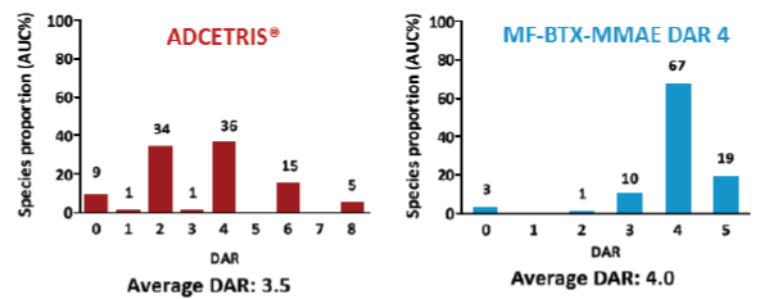
67% vs. 36%
Molecules at DAR 4
3% vs. 9%
Unconjugated antibody (DAR 0)
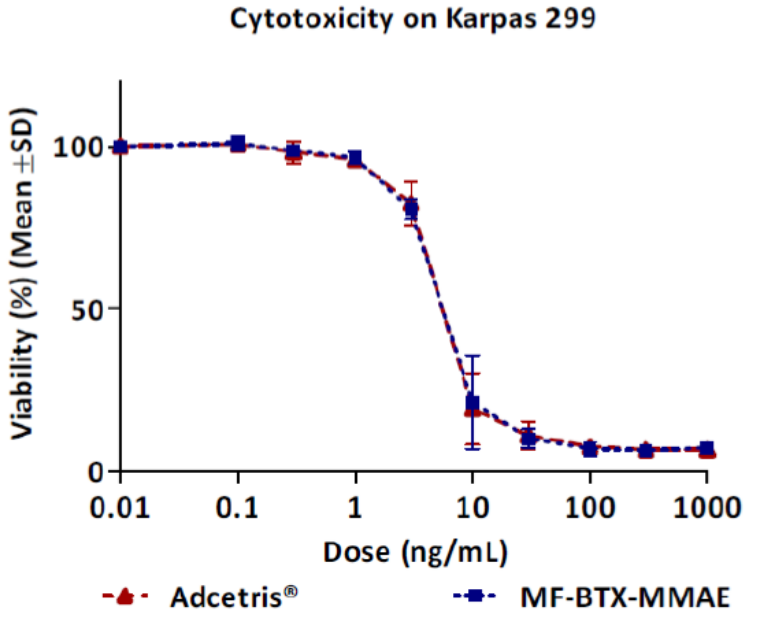
0.104 vs. 0.105 nM
EC50 on Karpas 299 cells
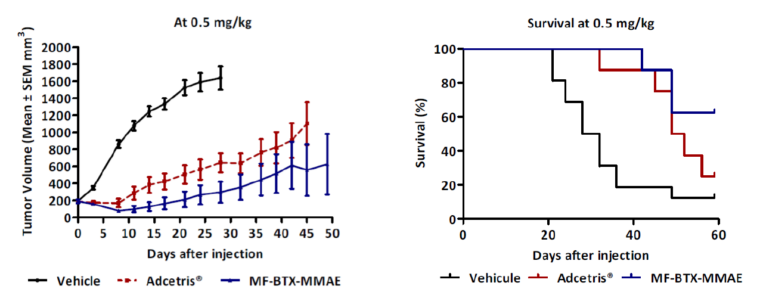
5/8 vs. 2/8
Mice alive at day 59
DAR DISTRIBUTION
A More Defined DAR Profile
DAR 4 was the dominant species in the ProteoGenix ADC, compared with the broader DAR distribution observed for Adcetris®.
IN VITRO POTENCY
The two ADCs showed similar EC50 values against Karpas 299 cells: 0.104 nM versus 0.105 nM.
IN VIVO RESULTS
The ProteoGenix ADC produced stronger tumor growth inhibition in the presented model, with 5 of 8 mice remaining alive at Day 59 compared with 2 of 8 for Adcetris®.
Comparison 02
HER2+ breast cancer model
ProteoGenix developed a site-specific trastuzumab ADC using its proprietary cysteine rebridging technology and evaluated it against T-DM1 (Kadcyla®). Our study demonstrates a more controlled conjugation wile preserving key antibody properties.
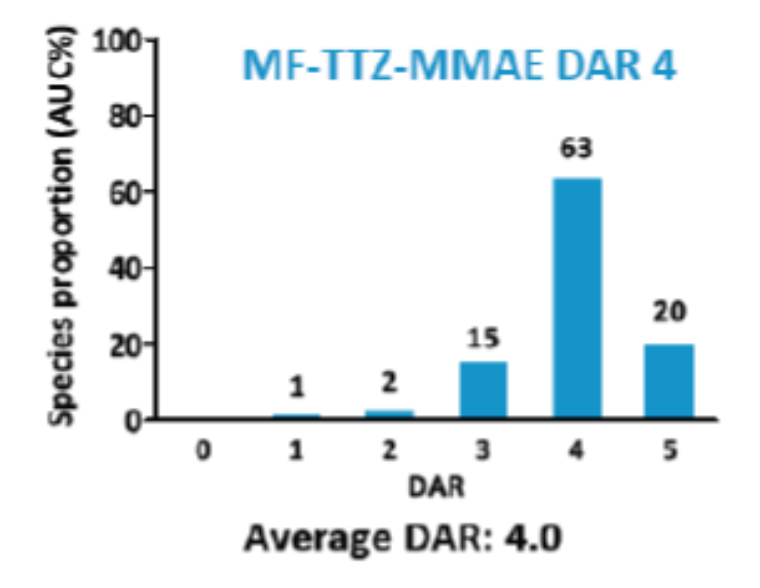
63%
Average DAR: 4.0
ADC species at DAR 4
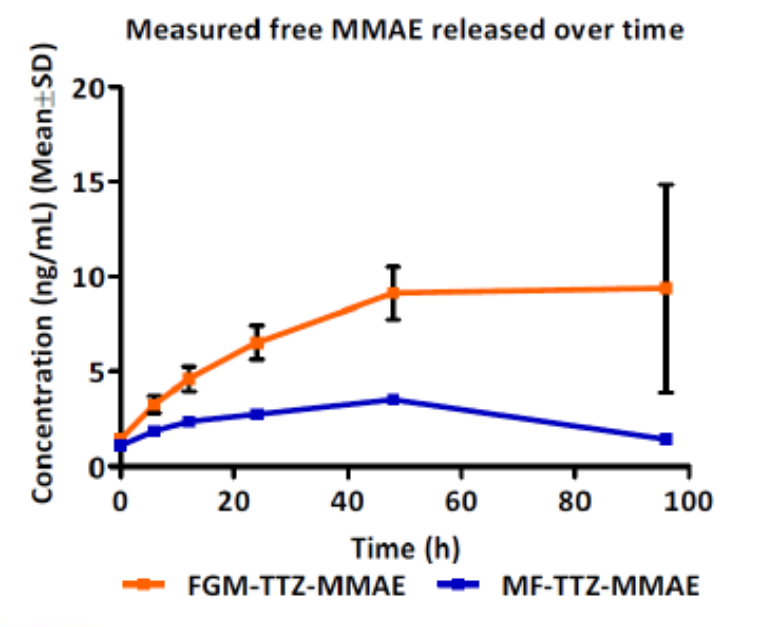
≈ 1–2 ng/mL
vs. ≈ 9–10 ng/mL
Free MMAE after 96 h in human plasma
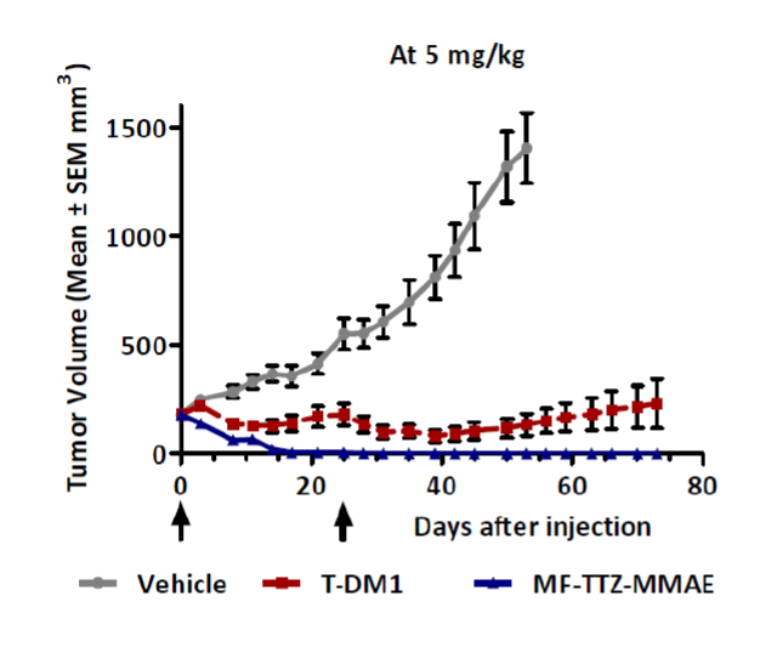
5 mg/kg
In vivo dose
Near-complete tumor growth suppression in the tested model
HER2+
BT-474 cells
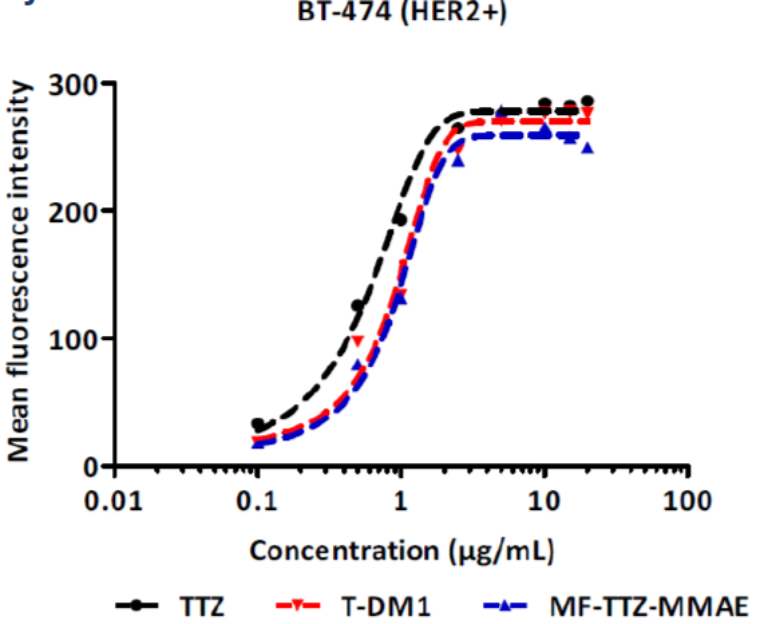
Antigen binding preserved after conjugation
DAR DISTRIBUTION
Defined DAR 4 population
The reported DAR profile shows 63% at DAR 4, with an average DAR of 4.0.
ANTIGEN BINDING
HER2 binding retained
Binding curves measured on BT-474 (HER2+) cells remain close to those of the reference antibodies.
PAYLOAD STABILITY
Lower free MMAE release
The MF-TTZ-MMAE curve remains below the FGM-TTZ-MMAE curve during the tested interval.
IN VIVO RESULTS
Tumor growth control at 5 mg/kg
The original plot shows the MF-TTZ-MMAE group near baseline while the T-DM1 group retains measurable tumor volume.
FROM FEASIBILITY TO DELIVERY
A feasibility-led approach to custom antibody conjugation, with analytical characterization built into the project.
01
Evaluate your antibody, payload and target DAR to define suitable conjugation conditions.
02
Apply the agreed conjugation strategy using proprietary Click chemistry on compatible native antibodies.
03
Purify the ADC and evaluate drug loading, purity and antibody integrity.
04
Receive the agreed ADC preparation and analytical information for your next development decisions.
Feasibility Study
Analytical results and optional test material to assess conjugation feasibility before scale-up.
Included in the package
~1 mg of test ADC material, upon request.
Full Conjugation
Purified ADC material and comprehensive analytical characterization following conjugation.
Included in the package
SDS-PAGE, SEC-HPLC, HIC-HPLC and MS.
IND-ENABLING DATA
Key quality attributes—including drug loading, DAR distribution, purity and antibody integrity—are assessed using complementary analytical methods to support ADC development and further regulatory documentation.
| Quality attribute | Why it matters | Method used |
|---|---|---|
| Quality attribute Average DAR |
Why it matters
Influences payload delivery, potency and pharmacokinetic properties.
|
Method used HIC-HPLC, LC-MS |
| Quality attribute DAR distribution / homogeneity |
Why it matters
Helps assess conjugation consistency and product heterogeneity.
|
Method used HIC-HPLC |
| Quality attribute Aggregation / monomeric purity |
Why it matters
Evaluates aggregate levels, a potential quality and immunogenicity concern.
|
Method used SEC-HPLC |
| Quality attribute Antibody integrity |
Why it matters
Assesses the integrity of the antibody following conjugation.
|
Method used SDS-PAGE |
| Quality attribute Unconjugated antibody (DAR 0) |
Why it matters
Quantifies antibody without payload, which may compete for target binding.
|
Method used HIC-HPLC, LC-MS |
WORK WITH PROTEOGENIX
From feasibility to site-specific conjugation and analytical characterization, ProteoGenix builds a development strategy around your antibody, payload and target DAR.
Beyond Conjugation
Progress smoothly from early-stage conjugation to cell line development and CDMO transfer for clinical-grade production.
Generate or produce the antibody you want to conjugate.
Feasibility, site-specific conjugation and characterization.
Stable, high-yield cell lines for your lead antibody.
Transfer to an external CDMO partner for clinical-grade production.
Clinical Relevance
Five ADC candidates developed using this conjugation technology have progressed to clinical trials, demonstrating its application beyond early-stage research.
SCIENTIFIC PUBLICATIONS
Elisa Rioja-Blanco, Yara Banz, Christoph Schlapbach, Urban Novak, Tanja Chiorazzo, Nicole L. Bertschi, Peter Bernhardt, Pascal V. Grundler, Nicholas P. van der Meulen, Michal Grzmil, Roger Schibli, Martin Behe
Journal of Nuclear Medicine Jun 2025, 66 (6) 909-915; DOI: 10.2967/jnumed.124.268805
LET’S DISCUSS YOUR PROJECT
Whether you already have a purified antibody or need help defining the conjugation strategy, start with a technical discussion.
Not sure where to start?
Already have a purified antibody or a payload in mind? Tell us what you have and what you want to achieve. Our team will help assess feasibility and define the appropriate conjugation approach.