Cart (0 Items)
Your cart is currently empty.
View ProductsIt looks like you are visiting from outside the EU. Switch to the US version to see local pricing in USD and local shipping.
Switch to US ($)
Client
Laboratorios LETI
Sector
Animal health
Application
Quality control and protein detection
Timeline
7 weeks
Key processes
Secured access to a critical legacy antibody
Removed dependency on a contaminated hybridoma
Enabled project continuity through recombinant production
Laboratorios LETI, active in animal health, partnered with ProteoGenix to secure the supply of a mouse monoclonal antibody developed by hybridoma technology in the late 1990s.
The antibody was used for quality control and protein detection, but the original hybridoma was contaminated with mycoplasma, making its continued use risky. Given the age of the cell line and the quality of the available genetic material, ProteoGenix recommended de novo antibody sequencing rather than conventional hybridoma DNA sequencing.
After sequence recovery, the VH and VL regions were grafted into the same murine IgG2a backbone and expressed recombinantly. This enabled the client to preserve the antibody and continue using it without needing to revive the original hybridoma.
Overcoming mycoplasma contamination
Choosing the right sequencing strategy
Rebuilding the antibody in a recombinant format
For this project, we adapted its workflow to the specific risks associated with an old and contaminated hybridoma cell line. Instead of relying on conventional DNA sequencing from the hybridoma, our team recommended a de novo sequencing strategy to recover the antibody sequence directly from the protein.
The antibody was analyzed by LC-MS/MS using a multi-enzymatic strategy to reconstruct the heavy and light chain sequences.
2. Recombinant antibody design
The recovered VH and VL regions were synthesized as CHO-optimized genes and cloned into ProteoGenix’s proprietary pTXs1 vector using the same murine IgG2a backbone as the original antibody.
3. Pilot recombinant production
The recombinant antibody was produced by transient transfection in XtenCHO™ cells, followed by pilot-scale expression (80L) and Protein A/G affinity purification.
4. Quality control
The purified antibody was analyzed by SDS-PAGE and UV280 to assess integrity and purity before delivery.
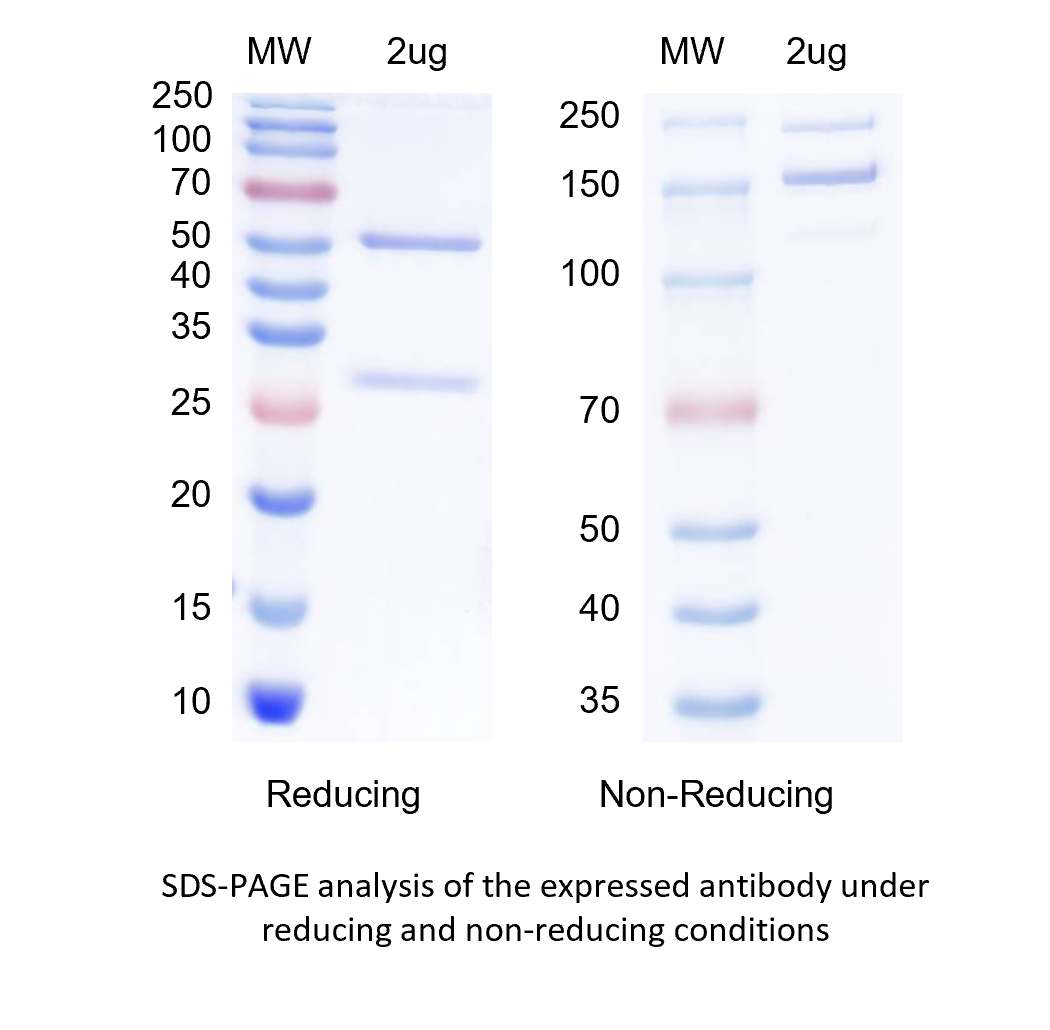
ProteoGenix successfully recovered the sequence of the legacy mouse monoclonal antibody and converted it into a recombinant format. SDS-PAGE analysis under reduced and non-reduced conditions confirmed the integrity and purity of the recombinant murine IgG2a antibody after Protein A/G purification.
The recombinant antibody was produced without the need to revive or further exploit the contaminated hybridoma cell line. After delivery, the client tested the recombinant antibody in their own hands and confirmed that it showed the same properties as the original hybridoma-derived antibody.
This gave Laboratorios LETI a reliable way to continue using a valuable antibody while removing its dependency on an old and contaminated cell line. By securing the molecule in a recombinant format, the project helped preserve a critical legacy antibody, reduce the risk of supply disruption, and support continued quality control and protein detection applications.
Through de novo sequencing and recombinant antibody production, ProteoGenix helped Laboratorios LETI rescue a valuable legacy antibody from a contaminated hybridoma and secure its future use in recombinant format.
This approach removed the need to rely on the original cell line while preserving the antibody properties required for continued quality control and protein detection applications.
It was a real pleasure working with the ProteoGenix team. Everything went very smoothly, the coordination was close and efficient, and they were always quick to respond to any doubts or questions. We truly appreciated how attentive they were throughout the entire process; at all times, we felt the communication was fluid and proactive. The delivery timelines were perfectly met, which made the collaboration even more seamless. I’d be happy to work together with them again in the future.