Cart (0 Items)
Your cart is currently empty.
View ProductsIt looks like you are visiting from outside the EU. Switch to the US version to see local pricing in USD and local shipping.
Switch to US ($)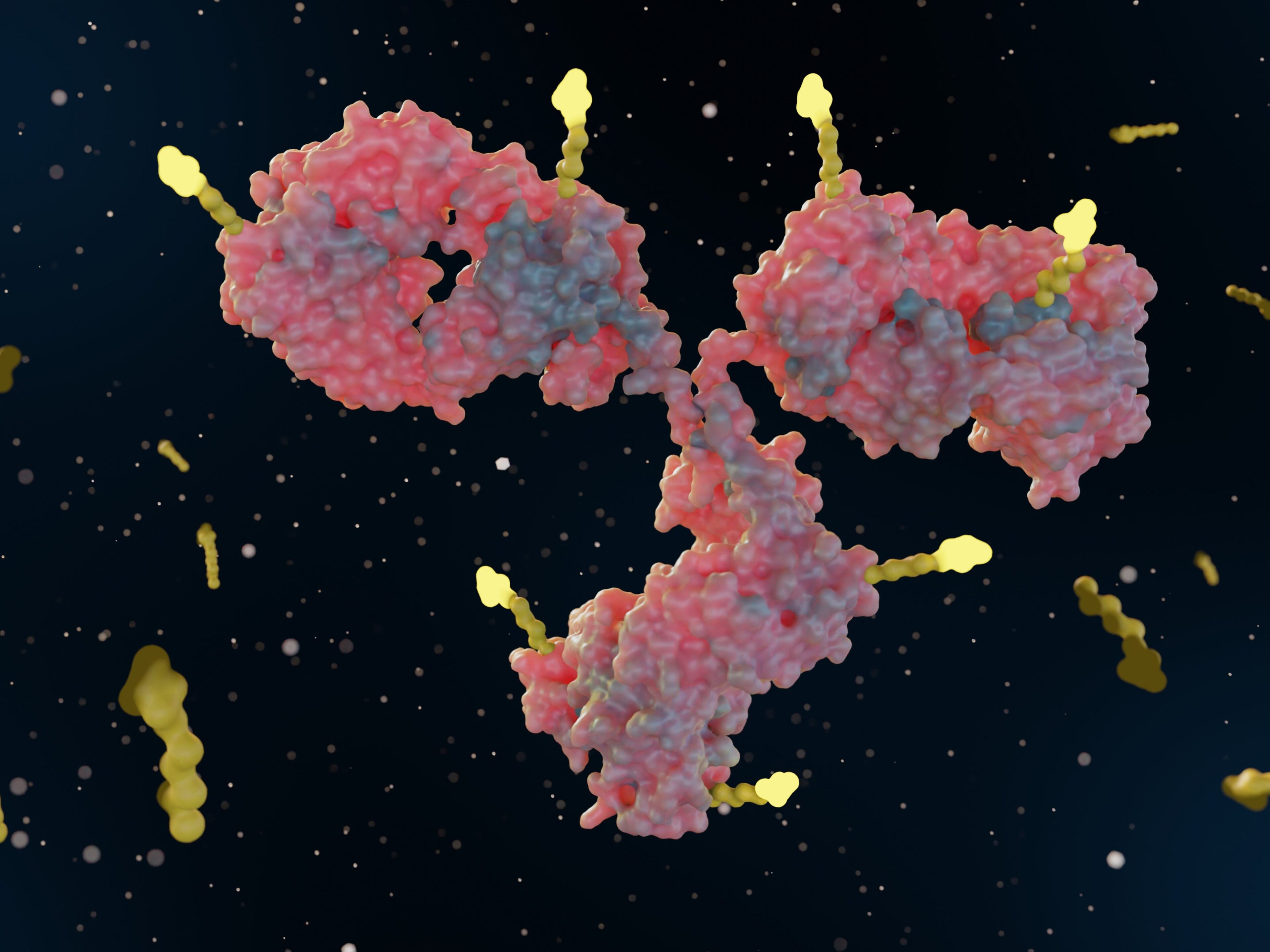
Let’s talk about your project Download the full case report
Australian University
Research
Immuno-Oncology
Ovarian cancer
The project aimed to generate a characterized ADC for an academic preclinical proof-of-concept study in ovarian cancer immuno-oncology. Using the client’s full-length human IgG1 antibody and selected Vc-MMAE payload, ProteoGenix developed a site-specific conjugation workflow targeting a DAR of 4 while preserving antibody integrity.
The development strategy was organized in two sequential phases. First, a feasibility study was performed to validate the experimental conditions and identify the best conjugation strategy. Second, the selected condition was transferred to a larger-scale coupling and characterization phase.
The final objective was to obtain a monoclonal antibody coupled to Vc-MMAE with a controlled DAR of 4 while preserving antibody integrity and limiting aggregation.
Achieving controlled conjugation to Vc-MMAE with a target DAR of 4
Maintaining antibody monomeric purity after the bioconjugation process
Preserving antibody integrity before and after conjugation
ProteoGenix implemented a two-step ADC development workflow, starting with a feasibility study to validate the conjugation conditions, followed by larger-scale coupling and characterization.
The native full-length human IgG1 antibody was first analyzed by HPLC-HIC, HPLC-SEC, and SDS-PAGE to confirm its suitability for conjugation. These analyses established the DAR 0 reference profile, confirmed that the antibody was predominantly monomeric, and showed no detectable fragmentation.
The antibody was buffer-exchanged into an appropriate phosphate buffer and conjugated to Vc-MMAE using a site-specific strategy based on a MC-Val-Cit-PAB linker. Several conditions were tested during the feasibility phase to identify the most suitable conjugation parameters.
The resulting ADC was characterized by HPLC-HIC, HPLC-SEC, and SDS-PAGE to assess DAR distribution, monomeric purity, aggregation, and antibody integrity. The best-performing condition was then applied to a larger-scale conjugation, using the same analytical workflow to confirm reproducibility and final ADC quality.
The feasibility phase confirmed that the customer-provided full-length human IgG1 antibody was suitable for site-specific conjugation to Vc-MMAE. The native antibody was predominantly monomeric, showed no detectable fragmentation by SDS-PAGE, and displayed a consistent HPLC-HIC retention time corresponding to DAR 0.
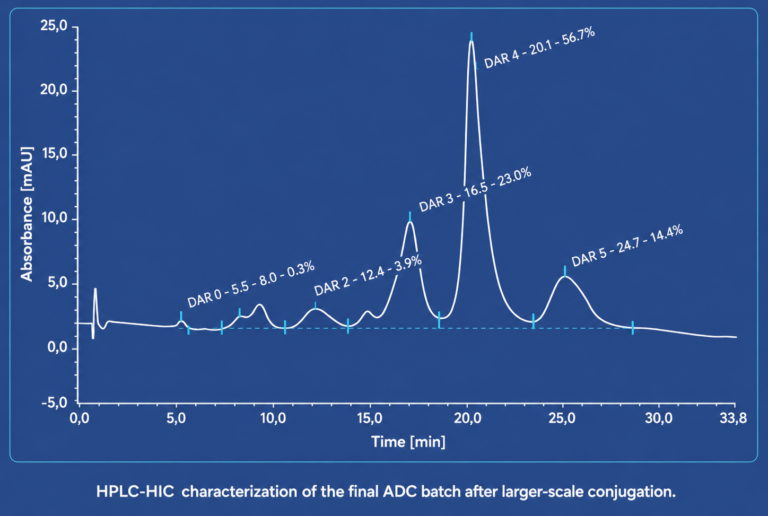
Following conjugation, HPLC-HIC demonstrated that the target DAR 4 species was predominant, with an average DAR of 4.0. SEC analysis confirmed that the conjugation process did not induce detectable aggregation, with a monomeric purity of 96.1%.
The larger-scale conjugation reproduced the feasibility results with a similar HPLC-HIC profile. As shown in the figure, the final ADC batch displayed a predominant DAR 4 species, representing 56.7% of the relative peak area, with an average DAR of 3.8. SEC analysis confirmed the absence of aggregation after conjugation, with a monomeric purity of 92.2%.
A little over 6 mg of final ADC was delivered to the client, together with a complete analytical report. This provided the academic team with a characterized ADC batch and the supporting data needed to continue their preclinical proof-of-concept evaluation in ovarian cancer immuno-oncology.
Together, these analytical results confirmed that the site-specific conjugation strategy enabled controlled coupling of the full-length human IgG1 antibody to Vc-MMAE while preserving antibody integrity and maintaining high monomeric purity.
ProteoGenix developed a site-specific ADC conjugation workflow for a full-length human IgG1 antibody coupled to Vc-MMAE, supporting an ovarian cancer preclinical proof-of-concept project.
By combining feasibility testing, controlled conjugation, and analytical validation, ProteoGenix helped reduce development risk while addressing the project’s main challenges: confirming antibody suitability, achieving a DAR close to 4, and preserving ADC quality after conjugation.
Let’s talk about your project Download the full case report