Cart (0 Items)
Your cart is currently empty.
View ProductsIt looks like you are visiting from outside the EU. Switch to the US version to see local pricing in USD and local shipping.
Switch to US ($)AI + Wet-Lab Validation
AI-driven design combined with wet-lab validation to optimize antibody affinity while monitoring developability.
Why ProteoGenix?
Increase antibody affinity while considering the properties that matter for downstream development.
Up to 1,000×
Strengthens binding to lower your effective dose or sharpen assay sensitivity.
Wet-Lab Validated
Every AI-proposed mutation is reviewed by a bioinformatician, then tested at the bench.
Multi-Criteria
Each variant is ranked on several criteria, including developability.
≥10×
Minimum 10-fold affinity increase guaranteed with the AI-driven approach.
100% IP Free
You own 100% of the IP, with no royalties or milestone payments.
25+ Years
ProteoGenix has supported 970+ antibodies through preclinical development and clinical trials.
Two Affinity Maturation Approaches
Choose between targeted AI-guided optimization and a library-based wet-lab affinity maturation strategy.
Targeted antibody variant design followed by experimental production, binding validation and iterative optimization.
A wet-lab-only approach based on targeted controlled-mutagenesis VH/VL libraries and iterative biopanning.
From 3 Weeks
A structured, iterative design process combines AI-guided variant generation with experimental validation. You receive at least 20 purified, ready-to-use affinity-optimized antibody variants.
01
Epitope–paratope mapping and machine-learning-guided amino-acid substitutions are used to design candidate variants.
02
20 selected variants are expressed and purified with full quality control.
03
Every variant is screened by ELISA titration against the antigen. The best-performing variants undergo KD measurement by SPR or BLI.
04
Experimental results sharpen the next AI design round. Up to 3 rounds can be performed to converge on the best candidate.
AI prediction doesn’t end at sequence design.
Candidates are experimentally tested, and the resulting data can inform subsequent design rounds.
Multi-Criteria Variant Selection
Every affinity-matured variant is scored in parallel against additional criteria, helping keep the highest-affinity candidates viable for further development.
AFFINITY IS NOT OPTIMIZED IN ISOLATION
High-affinity variants are prioritized based on their overall profile and suitability for further development.
WHY IT MATTERS
Deprioritizing high-risk variants at this stage helps protect your timeline and budget, well before scale-up or manufacturing decisions are made.
Optimized antibody variants together with the sequences, reports and experimental data generated during your project.
✓ Affinity-Improved Antibody VariantPurified and ready-to-use antibody variant with the guaranteed affinity improvement according to the selected approach.
✓ Designed VH/VL SequencesDesigned VH/VL sequences and proposed VH/VL combinations.
✓ Epitope/Paratope ReportDetailed epitope/paratope analysis supporting the design strategy.
✓ Experimental DatasetBinding data and available developability information generated during the project.
✓ Ready-to-Use CandidatesSelected affinity-optimized candidates for subsequent evaluation and development.
✓ 100% IP OwnershipNo royalties or milestone payments.
Case Study
A pharmaceutical company wanted to increase the affinity of a diagnostic antibody for neurodegenerative disease detection.
20
AIxplore®-designed variants
Up to 20×
higher affinity vs parental antibody
BLI + ELISA
experimental validation
3D structural analysis
backbone stability & developability
Experimental Results
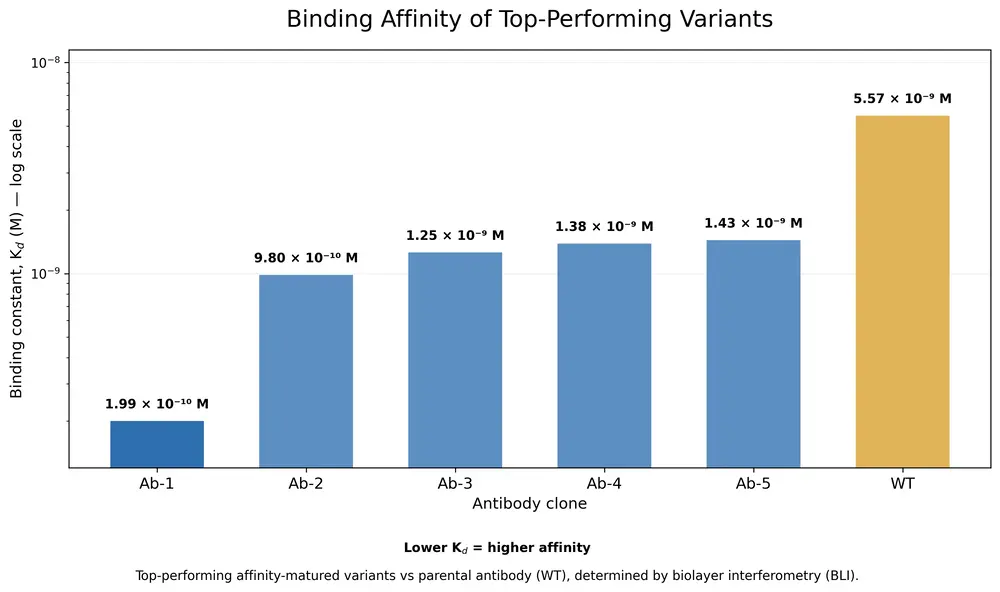
Key Result
Paratope–epitope mapping guided rational, targeted design. 20 AIxplore® variants were reviewed by our bioinformatics team before laboratory testing.
The lead variant showed increased affinity by BLI, with validation by SDS-PAGE and ELISA titration.
Backbone stability and developability were confirmed by 3D structural analysis across variants.
Compare the Approaches
| Criteria | AI-Driven Maturation | Phage Display |
|---|---|---|
| Approach | Deep-learning targeted paratope substitutions, structure-informed when epitope is known |
Controlled-mutagenesis VH/VL libraries enriched by iterative biopanning |
| Antigen structure | Works with or without epitope knowledge | Antigen required for panning |
| Iteration | Up to 3 learning rounds, with experimental results informing subsequent rounds |
4–6 panning rounds per library |
| Variants assessed | Up to 20 designed variants per round | Enriched pool followed by ≥96 clones screened by ELISA |
| Validation | ELISA followed by SPR/BLI for KD | ELISA + sequencing of unique binders |
| Developability | Basic developability monitored during selection | Optional |
| Turnaround | From 3 weeks | From 7 weeks |
| IP | 100% IP free | 100% IP free |
Our scientists can review your antibody, available data and project objectives to recommend the most suitable strategy.
Extend your affinity maturation project with additional antibody optimization or production services when needed.
Convert non-human antibodies into humanized candidates in 3–4 weeks.
Go beyond affinity with deeper stability, aggregation and manufacturability screening.
Produce purified antibodies from milligram to gram scale, delivered in 15 business days.
Develop royalty-free stable cell lines, with top clones reaching 8 g/L and monoclonality assurance via VIPS™.
START YOUR PROJECT
Tell us about your antibody, target and affinity goals. Our scientists will review your project and recommend the most suitable affinity maturation strategy.
Every affinity maturation project starts differently
Share your available antibody data and project objectives. We’ll identify the most suitable next steps.
Your project will be reviewed by our antibody engineering team.