It looks like you are visiting from outside the EU. Switch to the US version to see local pricing in USD and local shipping.

Switch to US ($)

Get 25% off your first bioreagent online order — use code: PROTEOSHOP25

Anti-Immune checkpoint proteins

Anti-Immune checkpoints Antibodies

Immune checkpoint proteins
Immune checkpoints are cell surface molecules that regulate the immune response. They are controlling immune cell signaling. They play a major role in self-tolerance and avoid autoimmunity. They act in relation to their respective receptors. Many Clusters of Differentiation proteins are among this class. The immune checkpoint proteins have a lifecycle beginning from their expression in the endoplasmic reticulum to their transport to the cell surface and further internalization and degradation or recycling. All this process can be regulated by complex mechanisms, explaining checkpoint signaling efficiency, that are currently under study.
Inhibitory and stimulatory checkpoint proteins
There are two types of Immune checkpoints, inhibitory and stimulatory, according to the type of signal they carry. The equilibrium between the expression levels of those two types determines the transmissibility of the immune signal.

The inhibitory immune checkpoints block the immune response. This is the case of Programmed cell death protein 1(PD1). This protein, if carried by a cell, will prevent the immune signaling cascade to be transmitted upon binding with its ligand Programmed death-ligand 1(PD-L1). PD-L1bearing cells can be thus protected from apoptosis.

The stimulatory immune checkpoints promote the transmission of the immune response. Among these proteins a few Tumor Necrosis Factor Receptors can be found.
Immune Checkpoint blockade
In tumor cells immune checkpoints inhibitors might be overexpressed. Therefore they can protect those cells from lysis, inducing signal suppression. Current cancer research develops a strategy against the immune checkpoints inhibitors to let immune system eliminate the cancer cells. The immune checkpoint blockade, in immunotherapy, consists in developing neutralizing anti-checkpoint protein antibodies to prevent the down regulating signal to be transmitted. This way tumor cells can be killed and the progression of cancer slowed down or stopped. Several drugs have been validated in this system targeting especially PD1 or CTLA-4. Although having more durable effect than other cancer treatment, this immunotherapy technique may have a low response in different types of cancers.

ProteoGenix offers Immune checkpoint proteins and the respective antibodies to help research strive in this promising area.

207 products
  • Flow Cytometry results for Anti-Human TIGIT Antibody (SAA1407)

    Anti-Human TIGIT Antibody (SAA1407)

    • ARO-A15361
    • Validated FC
    Brand:
    ProteoGenix
    Size:
    100ug, 1MG, 50ug
  • SDS-PAGE for Anti-Human TYRP1 Monoclonal Antibody, TA99

    Anti-Human TYRP1 Monoclonal Antibody, TA99

    • PTX19205
    Brand:
    ProteoGenix
    Size:
    100ug, 1MG, 50ug
  • Anti-LGALS9 Polyclonal antibody in WB Assay

    Anti-LGALS9 Polyclonal antibody

    • ARO-A14375
    • Validated WB
    Clonality:
    Polyclonal Antibody
    Host species:
    Rabbit
    Isotype:
    IgG
    Brand:
    ProteoGenix
    Size:
    100ug, 1MG, 50ug
  • SDS-PAGE for Anti-Mouse CD134/TNFRSF4/OX40 Antibody (OX-86)

    Anti-Mouse CD134/TNFRSF4/OX40 Antibody (OX-86)

    • ARO-A15692
    Brand:
    ProteoGenix
    Size:
    100ug, 1MG, 50ug
  • Flow Cytometry results for Anti-Mouse CD137/4-1BB/TNFRSF9 Antibody (3H3)

    Anti-Mouse CD137/4-1BB/TNFRSF9 Antibody (3H3)

    • ARO-A15698
    • Validated FC
    Brand:
    ProteoGenix
    Size:
    100ug, 1MG, 50ug
  • Anti-Mouse CD152/CTLA4 Antibody (9D9) binds to Mouse CD152 recombinant protein in ELISA Assay

    Anti-Mouse CD152/CTLA4 Antibody (9D9)

    • ARO-A15658
    • Validated ELISA
    Brand:
    ProteoGenix
    Size:
    100ug, 1MG, 50ug
  • Anti-Mouse CD152/CTLA4 Antibody (H11) binds to Mouse CD152 recombinant protein in ELISA Assay

    Anti-Mouse CD152/CTLA4 Antibody (H11)

    • ARO-A15655
    • Validated ELISA FC
    Brand:
    ProteoGenix
    Size:
    100ug, 1MG, 50ug
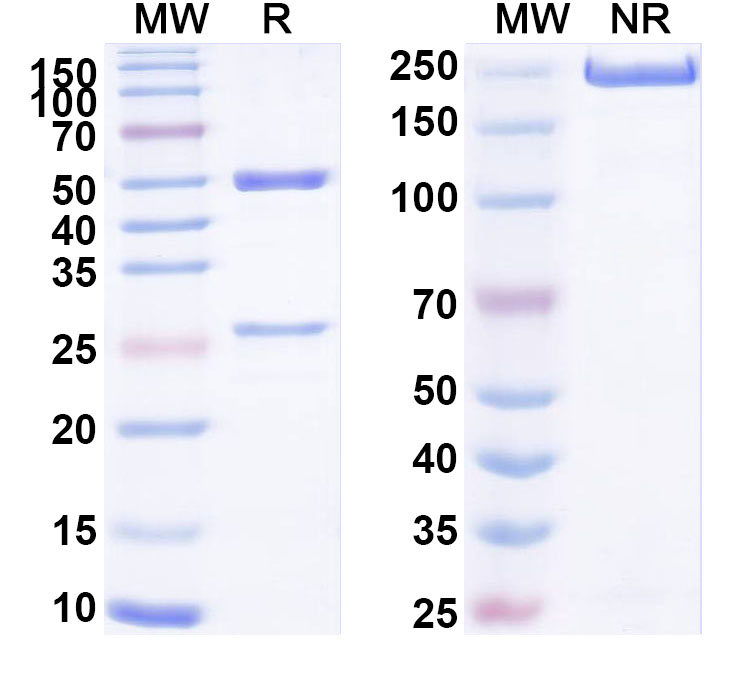
  • SDS-PAGE for Anti-Mouse CD152/CTLA4 Antibody (SAA2332)

    Anti-Mouse CD152/CTLA4 Antibody (SAA2332)

    • PTX27003
    Clonality:
    Monoclonal Antibody
    Brand:
    ProteoGenix
    Size:
    100ug, 1MG, 50ug
  • Flow Cytometry results for Anti-Mouse CD154/CD40L/TNFSF5 Antibody (MR1/MR-1)

    Anti-Mouse CD154/CD40L/TNFSF5 Antibody (MR1/MR-1)

    • ARO-A15661
    • Validated FC
    Brand:
    ProteoGenix
    Size:
    100ug, 1MG, 50ug
  • Flow Cytometry results for Anti-Mouse CD16/CD32 Antibody (2.4G2)

    Anti-Mouse CD16/CD32 Antibody (2.4G2)

    • ARO-A15670
    • Validated FC
    Brand:
    ProteoGenix
    Size:
    100ug, 1MG, 50ug
  • Anti-Mouse CD160 Polyclonal Antibody binds to Human CD160 recombinant protein in WB Assay

    Anti-Mouse CD160 Polyclonal Antibody

    • ARO-A12811
    • Validated WB
    Clonality:
    Polyclonal Antibody
    Host species:
    Rabbit
    Brand:
    ProteoGenix
    Size:
    100ug, 1MG, 50ug
  • SDS-PAGE for Anti-Mouse CD172a/SIRPA Antibody (SAA0817)

    Anti-Mouse CD172a/SIRPA Antibody (SAA0817)

    • ARO-A15421
    Brand:
    ProteoGenix
    Size:
    100ug, 1MG, 50ug
  • SDS-PAGE for Anti-Mouse CD19 Antibody (1D3)

    Anti-Mouse CD19 Antibody (1D3)

    • ARO-A15674
    Brand:
    ProteoGenix
    Size:
    100ug, 1MG, 50ug
  • Anti-Mouse CD19 Polyclonal Antibody binds to Human CD19 recombinant protein in WB Assay

    Anti-Mouse CD19 Polyclonal Antibody

    • PTX19983
    • Validated WB
    Clonality:
    Polyclonal Antibody
    Host species:
    Rabbit
    Isotype:
    IgG
    Brand:
    ProteoGenix
    Size:
    100ug, 1MG, 50ug

Need a quote or more information? Contact us!

    Cart (0 Items)

    Your cart is currently empty.

    View Products