Cart (0 Items)
Your cart is currently empty.
View ProductsIt looks like you are visiting from outside the EU. Switch to the US version to see local pricing in USD and local shipping.
Switch to US ($)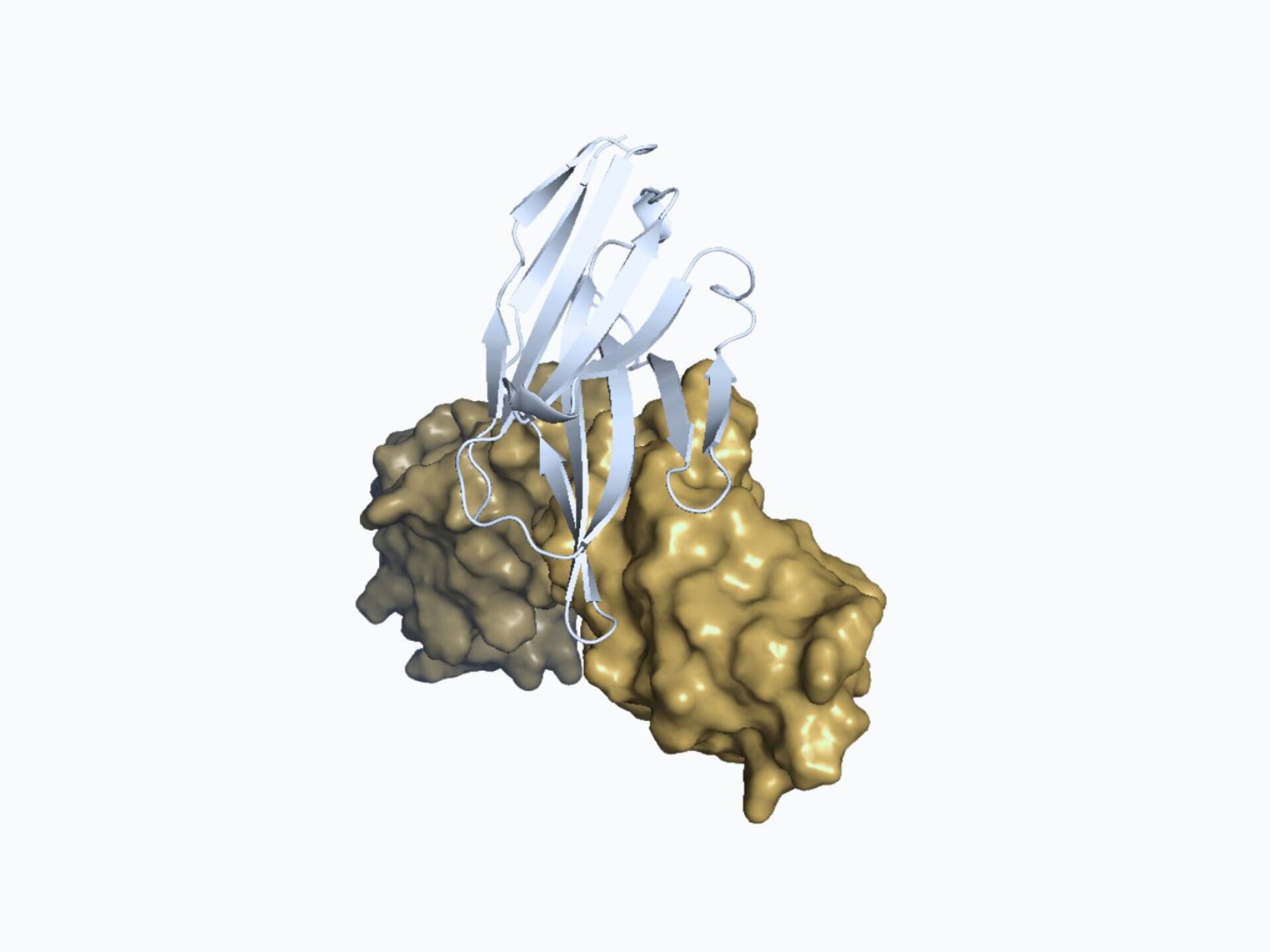
Case report
VHH candidates designed de novo and produced
confirmed specific binders by ELISA (32.6% hit rate)
SPR-measured apparent KD of the lead candidate
Contact us Talk to our Experts
Client
Biotech company
Sector
Biotech / oncology research
Target
Cancer associated protein neo-epitope
Format
VHH (single-domain antibody)
Key processes
The client, a biotech company, partnered with ProteoGenix to generate VHH single-domain antibodies against a cancer-associated protein neo-epitope. The client provided the target structure, together with the exact linear epitope to target, and requested VHH-format candidates specifically.
ProteoGenix’s AIxplore® platform generated candidate binders directly from this epitope and structure through AI-driven de novo design, without an immunization step or a phage display library screen.
01
Designing binders against a short linear epitope rather than a larger conformational surface
02
Confirming binding against the full-length antigen after an initial design phase against the epitope, to rule out steric clashes
03
Telling genuine high-affinity binding apart from aggregation- or avidity-driven artifacts across three different biophysical assays
04
Producing and quality-controlling 46 individual VHH-Fc constructs in parallel to consistent purity and endotoxin standards
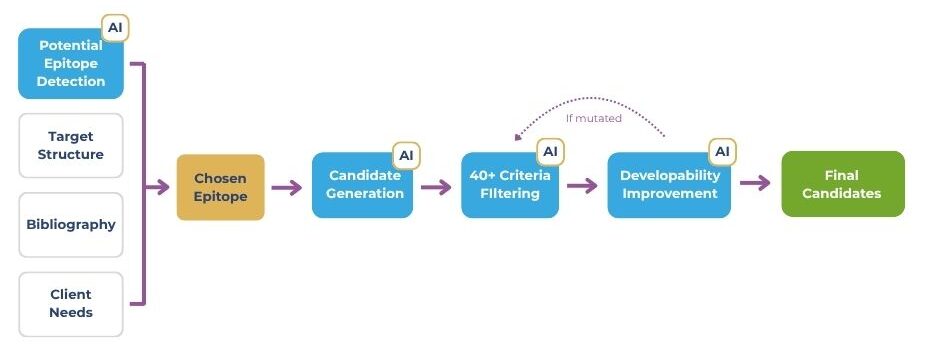
For this project, ProteoGenix ran its full de novo VHH workflow end to end, from epitope-guided design to multi-tier biophysical validation.
01
Epitope-guided de novo design
Using the client-provided structure, AIxplore® generated a diverse pool of candidate VHH sequences through AI-driven modelling.
02
Multi-stage filtering and affinity maturation
Candidates were first filtered against a truncated antigen construct (219 sequences passed), then re-evaluated against the full-length structure to exclude steric clashes (141 passed). A consensus score combining structural compatibility, interface stability and interface energetics ranked the top 100 sequences for CDR-focused affinity maturation by residue mutagenesis. Developability screening for aggregation risk, PTMs and liability motifs narrowed the pool to a final 46 candidates, all still targeting the intended epitope.
03
Recombinant production
The 46 VHH-Fc sequences were codon-optimized, synthesized, and expressed by transient transfection in ProteoGenix’s XtenCHO™ Race system, then purified by Protein A affinity chromatography with SDS-PAGE and endotoxin quality control.
04
Tiered binding characterization
Binding was first screened by ELISA against the recombinant antigen. The three candidates with the lowest EC50 were then characterized by SPR (Biacore 8K), and six candidates in total were profiled by BLI (Octet R8) to confirm kinetics and check for nonspecific binding.
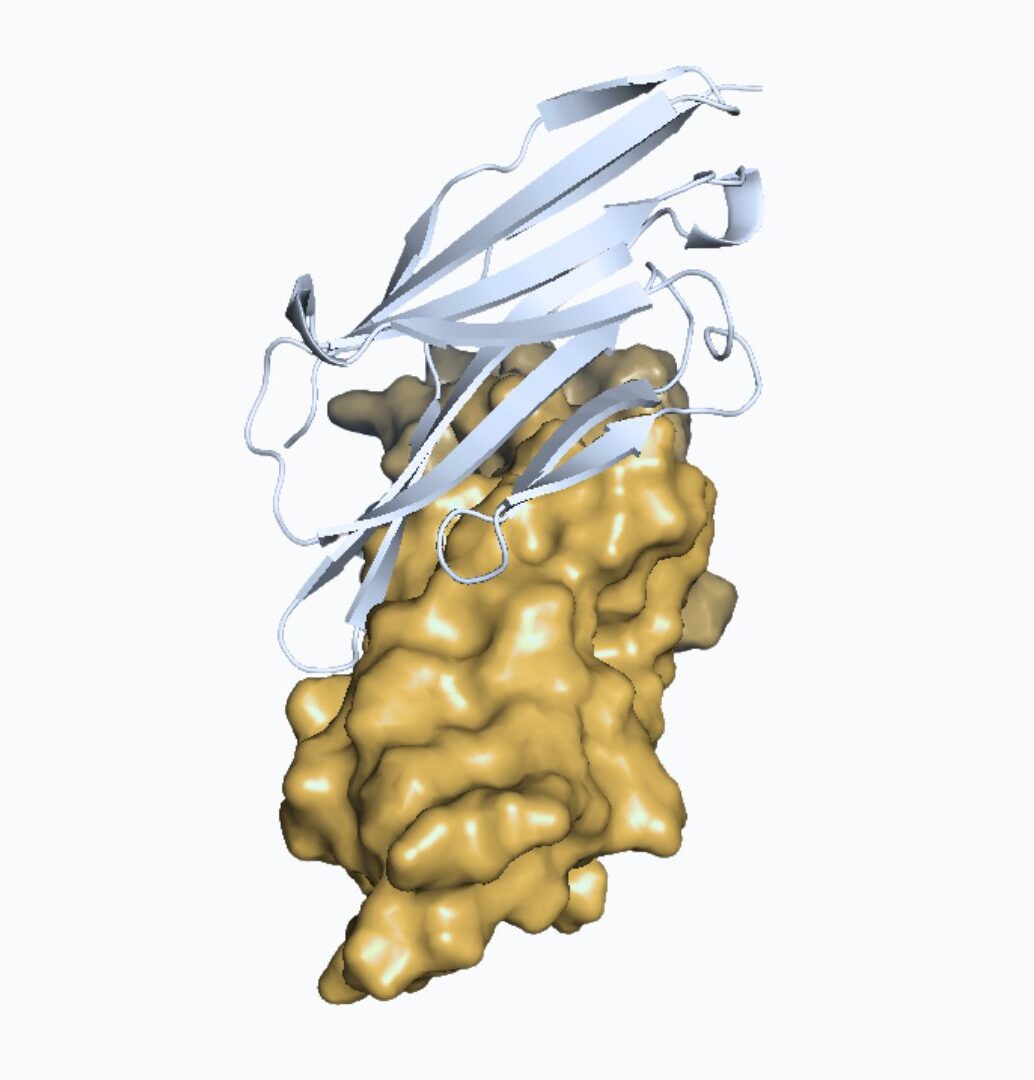
Of the 46 VHH-Fc candidates produced, 45 expressed and purified to over 90% purity with endotoxin levels below 10 EU/mL; one candidate, VHH A19, did not express in usable quantity.
By ELISA titration against the recombinant antigen, 15 of the 46 candidates, a 32.6% hit rate, showed a clear dose-dependent binding curve with a fittable EC50 (R² > 0.98).
Three candidates stood out with the lowest EC50: VHH A18 (0.196 µg/mL), VHH A15 (0.246 µg/mL) and VHH A12 (0.262 µg/mL). All three outperformed a commercial reference antibody run in the same assay (EC50 0.335 µg/mL).
These three candidates were characterized by SPR on a Biacore 8K. VHH A15 and VHH A18 showed clean, single-site binding kinetics, with a KD of 1.20 × 10⁻¹⁰ M (120 pM) for VHH A15 and 1.96 × 10⁻⁹ M (1.96 nM) for VHH A18. VHH A12’s sensorgram did not reach saturation, consistent with aggregation, so its apparent picomolar KD could not be considered a reliable affinity value. As all candidates were tested as bivalent VHH-Fc fusions, these KD values reflect combined affinity and avidity rather than monovalent binding affinity.
BLI (Octet R8) characterization was then expanded to six candidates: VHH A12, VHH A14, VHH A15, VHH A18, VHH A20 and VHH A37. Five of them showed high-affinity, single-digit nanomolar KD values, but VHH A12, VHH A20 and VHH A37 also showed detectable nonspecific binding on unloaded reference sensors. VHH A15 stood out with a clean profile, a KD of 1.83 × 10⁻⁹ M (1.83 nM) with no meaningful nonspecific signal, consistent with its clean SPR result.
Through de novo AI design on the AIxplore® platform, ProteoGenix generated, produced, and screened 46 VHH candidates against a single linear epitope, without an immunization step or a phage display library.
Fifteen candidates were confirmed as specific ELISA binders, several with a tighter EC50 than a commercial reference antibody. Orthogonal SPR and BLI characterization then identified VHH A15 as a clean, high apparent affinity lead, free of the aggregation and nonspecific-binding flags seen on some of the other top performers.
By combining a validated hit rate with a biophysically clean lead candidate in a single design cycle, this project gave the client a data-backed shortlist to carry into further development, without a wet-lab screening campaign from a naive library.