Cart (0 Items)
Your cart is currently empty.
View ProductsIt looks like you are visiting from outside the EU. Switch to the US version to see local pricing in USD and local shipping.
Switch to US ($)
Case report
46
VHH designed and produced from the target structure
24%
hit rate, 11 confirmed binders out of 46
10-20 nM
KD for the lead VHH, with no affinity maturation
Contact Us Talk to our Experts
Project type
Internal validation study, ProteoGenix AI business unit
Target
PD-L1 (CD274)
Format
VHH (single-domain)
Field
Immuno-oncology, checkpoint blockage
Reference points
Avelumab, Atezolizumab, Durvalumab, plus published de novo VHH
Key processes
De novo antibody design is judged on one question: does anything that comes out of the computer actually bind? Published success rates say the answer is usually no. In the September 2025 Germinal study from Stanford and the Arc Institute, an epitope-targeted generative framework reached experimental success rates of 4% to 22% across four protein targets, testing 43 to 101 designs per antigen.
ProteoGenix ran its own validation study on PD-L1 to measure where AIxplore® sits against that bar. PD-L1 is a demanding choice on purpose. Its structure is well described, three anti-PD-L1 antibodies are approved and available as reference molecules, and de novo VHH against it have already been published, which means every result can be placed next to an external number rather than reported in isolation.
The study asked three things:
01
Designing against one predefined epitope, rather than anywhere on the antigen surface
02
Published de novo hit rates stay low, between 4% and 22% in the Germinal study
03
Reaching a usable affinity with no wet-lab maturation and no library selection
04
Proving the lead binds the clinically relevant site, not just the antigen
01
Epitope definition and structural modelling
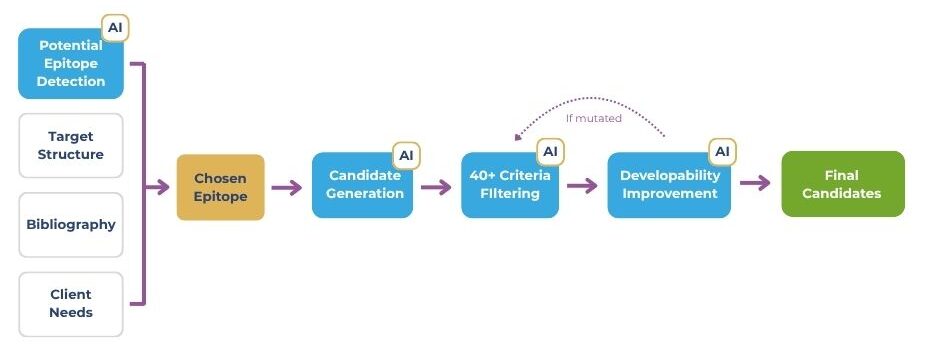
The design was aimed at a five-residue epitope on PD-L1: I37, Y39, E41, R96 and M98. The antigen structure and this interface were modelled in 3D to give the generative step a defined target rather than a whole surface.
02
AI sequence generation and filtering
AIxplore® generated VHH sequences against that epitope. Candidates were filtered on more than 40 parameters, including developability and affinity, so that the sequences moving to the bench were already screened for more than predicted affinity. Every output was reviewed by our bioinformaticians before selection.
03
Recombinant production of the full design set
All 46 selected VHH were expressed and purified, then quality controlled before testing. No candidate was dropped on a computational score alone.
04
Binding screen and EC50 determination by ELISA
Each VHH was tested against PD-L1 by ELISA. Eleven bound the antigen, and each of the eleven was titrated to obtain an EC50. Two de novo VHH from the published Germinal study were produced and run in the same assay as an external comparator.
05
Affinity measurement by BLI
The best candidate, VHH297, was characterised by biolayer interferometry to obtain KD, kon and koff. Avelumab was run alongside it as a clinical-grade anchor for the measurement.
06
Epitope binning against approved antibodies
VHH297 was tested by BLI epitope binning against Avelumab, Atezolizumab and Durvalumab to establish whether it occupies the same region of PD-L1 as the three approved molecules.
07
Sequence novelty check
The sequence of VHH297, and of its CDRs, was compared with the known anti-PD-L1 competitors to establish how much of the molecule is genuinely new.
Of the 46 VHH designed and produced, 11 bound PD-L1 in ELISA, a hit rate of 24%. That sits at the top of the 4% to 22% range reported in the Germinal study, on a comparable number of tested designs.
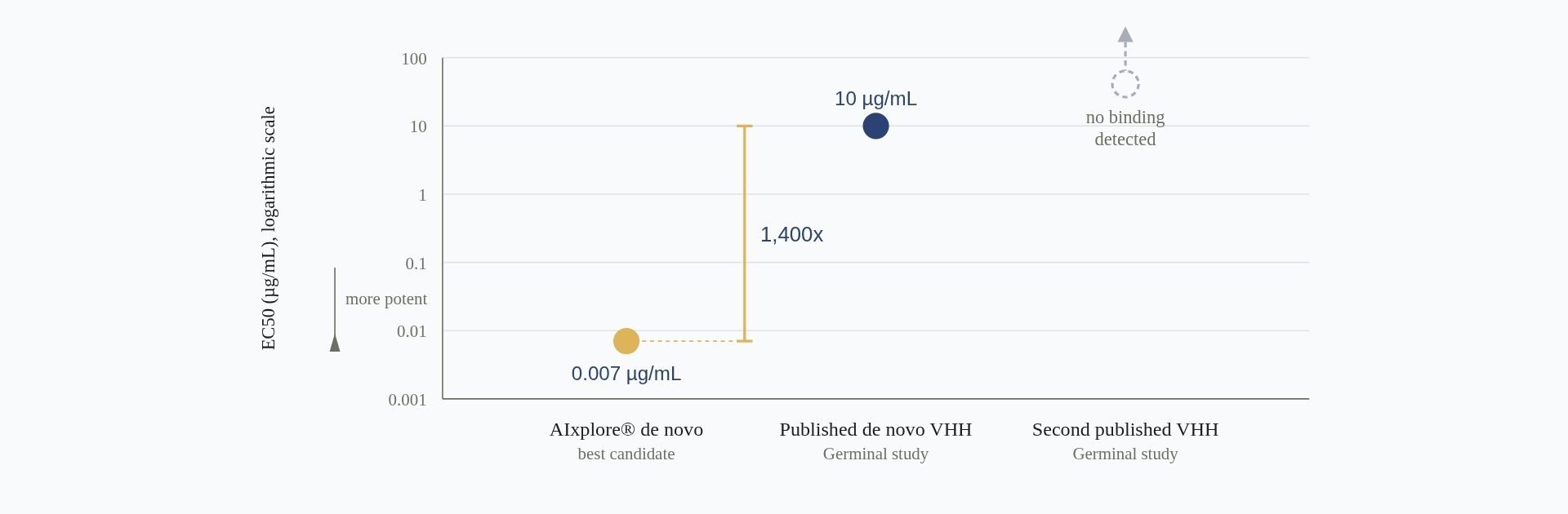
The two published de novo VHH were produced and tested in the same ELISA. One of the two showed no binding under these conditions. The one that did bind gave an EC50 of 10 µg/mL, against 0.007 µg/mL for the best ProteoGenix candidate, a difference of roughly 1,400-fold in the same assay.
Assay conditions differ from those used in the original publication, so these values describe relative performance in a single head-to-head experiment rather than a reproduction of published data.
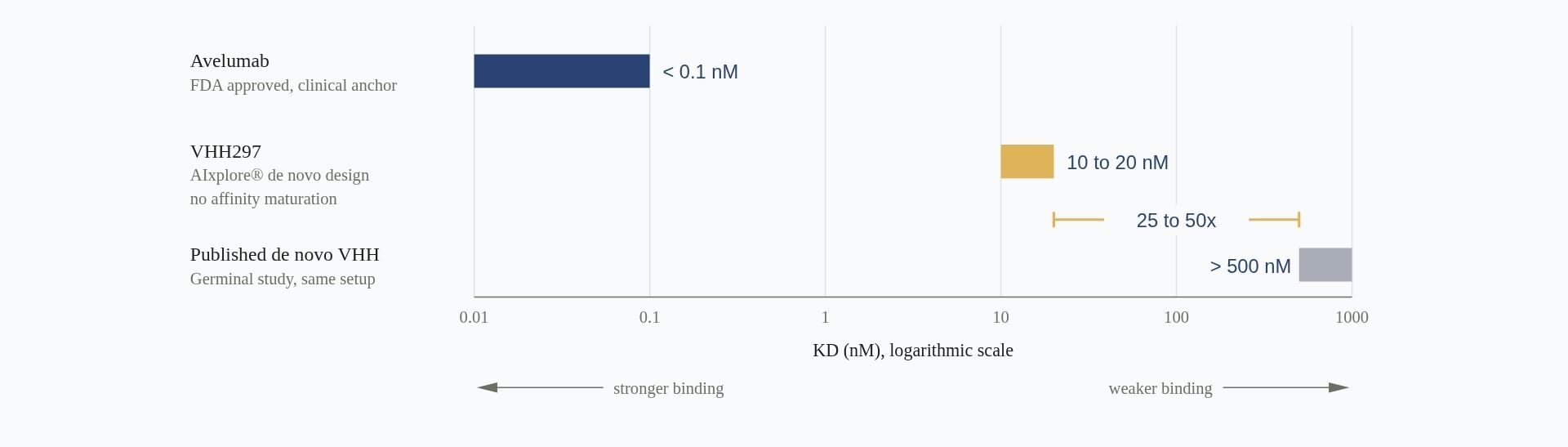
BLI on the lead candidate gave a KD between 10 and 20 nM, with kon of 2 x 10⁵ M-1s-1 and koff of 4 x 10⁻³ s-1. The published de novo reference measured above 500 nM in the same setup. Avelumab, an FDA-approved anti-PD-L1 antibody, was included as a clinical anchor and sits below 0.1 nM.
VHH297 therefore reaches nanomolar affinity as a first-pass design, roughly 25 to 50 times stronger than the published de novo comparator, with the gap to a clinical molecule still to be closed.
That gap is the starting point for AI-driven affinity maturation, which is the step this study deliberately left out.
Epitope binning by BLI showed VHH297 competing with Avelumab, Atezolizumab and Durvalumab. The candidate binds an epitope that is identical to, or strongly overlapping with, the one recognised by three clinically validated anti-PD-L1 antibodies.
Sequence comparison then showed that VHH297 and its CDRs are distinct from those known competitors. The molecule reaches a clinically relevant site through a sequence that does not exist in the published anti-PD-L1 landscape, which is what makes a de novo design useful in a freedom-to-operate discussion.
From a five-residue epitope and nothing else, AIxplore® produced 11 confirmed PD-L1 binders out of 46 designs, a 24% hit rate at the top of what the current literature reports. The lead candidate, VHH297, binds at 10 to 20 nM without any affinity maturation and competes with Avelumab, Atezolizumab and Durvalumab for the same region of the antigen, through CDR sequences unrelated to any of them.
For a discovery programme, that means a starting binder against a defined site, with no immunisation, no library, and no prior antibody to work from.