Cart (0 Items)
Your cart is currently empty.
View ProductsIt looks like you are visiting from outside the EU. Switch to the US version to see local pricing in USD and local shipping.
Switch to US ($)
Contact us Talk to our Experts
High-GC gene sequences present severe hurdles in custom gene synthesis and molecular cloning. When sequence regions exceed >60% GC content, heavy thermodynamic stability and dense secondary structures (such as stable hairpin loops and G-quadruplexes) often stall assembly workflows.
In this project, full-length gene synthesis was required for a challenging ~2,000 bp target gene with an overall GC content of 72%. The target construct was initially partitioned into three intermediate sub-fragments for initial synthesis.
While all three sub-fragments were successfully synthesized individually, joining them into the full sequence proved exceptionally difficult using standard high-throughput assembly protocols.
01
Gibson assembly overhang collapse
02
Junction deletions & frame-shifts
03
Internal restriction site conflicts
01
Sub-fragment synthesis
02
Initial Assembly attempt failed
03
Stepwise restriction & adapter bridge engineering
04
Biological strain & temperature optimization
Through this custom engineering workflow, ProteoGenix achieved 100% sequence accuracy, delivering the complete, error-free sequence verified by sequencing across all high-GC junctions.
The process resulted in zero target sequence alteration, ensuring the client received their exact target sequence without needing to introduce silent mutations or compromise on sequence design.
Furthermore, the construct demonstrated full plasmid stability, with structural integrity remaining 100% stable across multi-generational sub-culture passages.
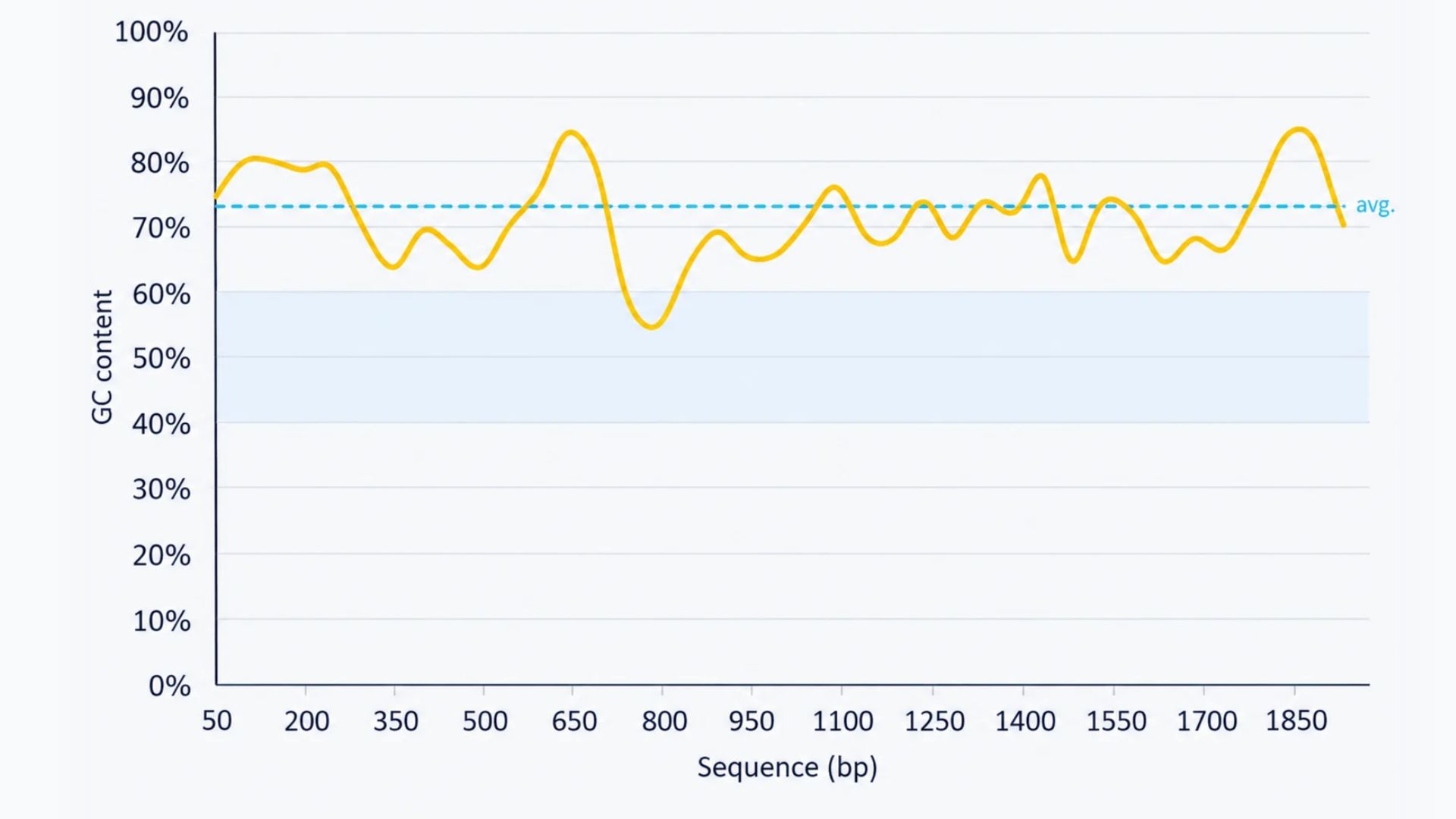
By developing a custom assembly strategy rather than relying on standard automated pipelines, ProteoGenix enabled the client to successfully obtain their complex, high-GC construct with 100% sequence accuracy. This dedicated technical troubleshooting allowed the client to overcome synthesis roadblocks without modifying their native gene sequence, keeping their program on schedule and providing a reliable foundation for downstream expression studies.
Need to express a complex gene?