Cart (0 Items)
Your cart is currently empty.
View ProductsIt looks like you are visiting from outside the EU. Switch to the US version to see local pricing in USD and local shipping.
Switch to US ($)
Client
INSERM U1312 (BRIC, Université de Bordeaux)
CNRS
Université de Bordeaux
Institute for Neurosciences of Montpellier (INSERM U1051, Université de Montpellier)
KU Leuven, and Université Paris Cité / INSERM U1266 (IPNP)
Sector
Biotechnology
Research Domain
Neuroscience / Vascular Biology
Target
Endothelial receptor Unc5B (Human & Rat)
Key Processes
Phage-Fab selection (5 rounds) on Unc5B-ECD-Fc
Screening & subcloning of unique Fabs
SPR kinetic analysis on Biacore™ 8K
A consortium of French and Belgian research institutions: INSERM U1312 (BRIC, Université de Bordeaux), CNRS, Université de Bordeaux, Institute for Neurosciences of Montpellier (INSERM U1051, Université de Montpellier), KU Leuven, and Université Paris Cité / INSERM U1266 (IPNP) was investigating how endothelial receptors maintain the blood–brain barrier (BBB) in adults.
To test the hypothesis that the receptor Unc5B controls BBB permeability through its interaction with Netrin-1, the scientists needed high-quality, function-blocking antibodies that could precisely disrupt this interaction without cross-reactivity. They also required accurate kinetic data to quantify the antibody’s binding properties and confirm its inhibitory effect.
Instead of developing and validating these complex tools in-house, which would have required significant time and resources, the team turned to ProteoGenix for support. By providing custom antibody generation and surface plasmon resonance (SPR) analysis, ProteoGenix enabled the consortium to rapidly obtain reliable reagents and quantitative binding data critical to advancing their research.
Generate antibodies that block Unc5B–Netrin-1 binding without cross-reactivity
Measure affinity constants in the nanomolar range to ensure biologically relevant precision
Demand for quantitative validation tools to confirm binding strength and specificity before moving to functional and in-vivo studies.
Cross-species consistency: Antibodies had to bind both human and rat Unc5B to support translational in-vivo models.
Phage-Fab selection using a naïve Fab library (Lib60) on recombinant rat Unc5B-ECD-Fc (R&D Systems).
Five rounds of panning with counterselection on unrelated protein to eliminate non-specific binders.
ELISA screening of individual clones from rounds 3–5 to identify specific anti-Unc5B binders.
Selection and subcloning of several unique Fabs before full antibody production (ProteoGenix, France).
Surface plasmon resonance (SPR) analysis performed on a Biacore 8K (ProteoGenix) to measure antibody binding kinetics to human and rat Unc5B-ECD-Fc
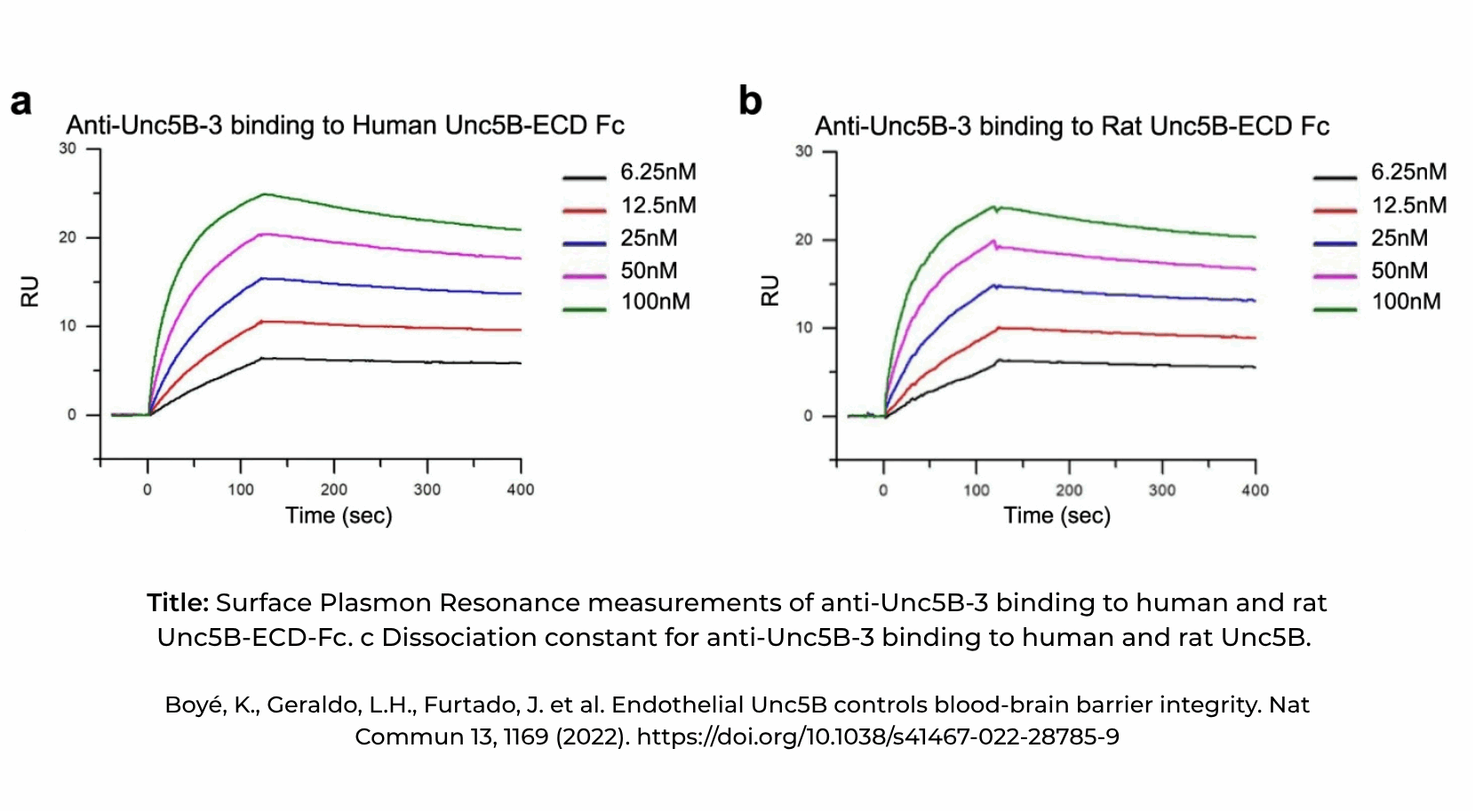
The custom antibodies generated by ProteoGenix demonstrated strong and specific binding to both human and rat Unc5B, as confirmed by surface plasmon resonance (SPR) analyses performed on the Biacore™ 8K platform. The measured affinities were 1.29 nM for human Unc5B and 1.34 nM for rat Unc5B, highlighting excellent cross-species performance and high binding precision. These quantitative results provided the research team with validated reagents ready for downstream biological testing. Using these antibodies, the consortium successfully demonstrated that blocking the Netrin-1–Unc5B interaction induces a transient and reversible increase in blood–brain barrier permeability. This finding established Unc5B as a critical regulator of endothelial signaling and opened new perspectives for controlled delivery of therapeutics to the brain.
Thanks to the antibodies and kinetic data delivered by ProteoGenix, the research consortium was able to rapidly validate its hypothesis and uncover the central role of Unc5B in maintaining blood–brain barrier integrity. The study revealed how Netrin-1–Unc5B signaling supports endothelial stability and demonstrated that targeted antibody blockade can transiently and safely open the barrier. This collaboration illustrates how reliable, high-quality reagents and precise biophysical characterization can accelerate academic discoveries and bridge fundamental research with translational opportunities in neuroscience.